June 13, 2026 • Declan Marsh • 10 min reading time • Prices verified June 11, 2026
Budget Tripods Compared: Amazon Basics, K&F, VICTIV, and CAMBOFOTO Tested by Real Owners

A tripod is exactly what it sounds like: a three-legged stand that holds your camera steady while you shoot. That matters more than beginners expect — even a slight camera shake during a one-second exposure or a slow-motion video clip ruins an otherwise perfect image. The problem is that tripod marketing is full of vague promises (“professional-grade,” “heavy-duty”) that mean almost nothing at the sub-$80 price point. This article cuts through that noise by looking at what real owners report after months of actual use across five popular budget models — the Amazon Basics 60-Inch Lightweight Tripod, the K&F Concept compact travel tripod, the VICTIV 72-Inch Camera Tripod, the CAMBOFOTO travel tripod, and the SmallRig CT-20 — so you can match the right stand to your actual shooting situation before you spend a dollar.
If you already shoot regularly and you’re just deciding which of these to buy (or whether to replace the head immediately), skip ahead to the comparison section. If you’re newer to the gear side of things, keep reading — we’ll name the trade-offs as clearly as possible.
What “Budget Tripod” Actually Means in 2026
The $30–$80 tripod market has gotten meaningfully better over the past three years. Petapixel’s budget tripod roundup noted that Chinese-manufactured aluminum tripods in this range routinely hit leg-lock and load-capacity specs that would have cost twice as much just five years ago. That said, Photography Life’s guide to choosing a tripod is direct about where budget builds still cut corners: the ball head (the rotating joint that lets you tilt and pan the camera) and the quick-release plate (the small clamp-and-plate system that attaches your camera to the head) are almost always the weakest links under $80.
That distinction matters because legs and center column are hard to upgrade cheaply, while a ball head swap is a $40–$120 fix that transforms a mediocre tripod into a capable one. Knowing which models ship with legs worth keeping — and heads worth replacing — is the practical decision frame here.
By the numbers — rated max load vs. real-world owner comfort zone:
| Tripod | Rated Max Load | Owner “comfortable” load | Packed Length | Tier |
|---|---|---|---|---|
| Amazon Basics 60” | 6.6 lbs | ~4 lbs | ~19 in | Amazon — $17.99 |
| K&F Concept compact | 17.6 lbs | ~6–8 lbs | ~13–15 in | Amazon — $17.99 |
| VICTIV 72” | 11 lbs | ~5–6 lbs | ~20 in | Amazon — $17.99 |
| CAMBOFOTO travel | 17.6 lbs | ~6–8 lbs | ~12–14 in | Amazon — $17.99 |
| SmallRig CT-20 | 17.6 lbs | ~8–10 lbs | ~16–18 in | VICTIV — $34.99 |
Rated loads are manufacturer-published specs. Owner comfort zones are drawn from aggregated review patterns and are not independently verified by this publication.
Model-by-Model: What Owners Actually Report
Amazon Basics 60-Inch Lightweight Tripod
The Amazon Basics tripod earns its reputation as the great confidence-breaker — in a good way. Owners consistently report being pleasantly surprised: the leg locks hold firmly and the included quick-release plate functions without issues for mirrorless bodies and lighter DSLRs. Setup is fast, and the overall build feels honest for the price.
Where it falls short: at 6.6 lbs rated capacity, heavy telephoto pairings push the center of gravity high enough that owners recommend keeping the center column partially retracted to reduce vibration. Wirecutter’s “The Best Tripods” guide specifically calls out center-column overextension as the most common mistake budget tripod users make — extend it fully and you’ve essentially built a monopod with two extra legs.
Quick-release plate compatibility note: The Amazon Basics uses a proprietary plate system, not Arca-Swiss — the near-universal standard used by most third-party heads and clamps. If you later want to use this tripod with an upgraded ball head or a gimbal head, you’ll need an adapter or a replacement clamp. Factor this in if you’re building toward a more capable kit.
Amazon
$17.99
In stock on Amazon
Check price on AmazonK&F Concept Compact Travel Tripod
K&F has built enough of a catalog reputation that The Phoblographer dedicates regular coverage to their ball head upgrades — which tells you something about who’s buying K&F. The compact model is popular with mirrorless shooters who need something that folds small enough for a daypack.
Owners praise the 360-degree ball head for its precision detents and smooth movement. The pattern that surfaces repeatedly across owner reviews: the ARCA-Swiss-style clamp is made of plastic, not aluminum, and several experienced photographers flag this as the first thing to replace. An aluminum ARCA clamp runs $20–$40 and is a meaningful upgrade. With that swap made, owners describe the K&F legs as genuinely solid for their size class. The full head replacement is optional unless you’re using heavy glass — the head mechanism itself is reasonable once the clamp issue is addressed.
Amazon
$17.99
In stock on Amazon
Check price on AmazonVICTIV 72-Inch Camera Tripod
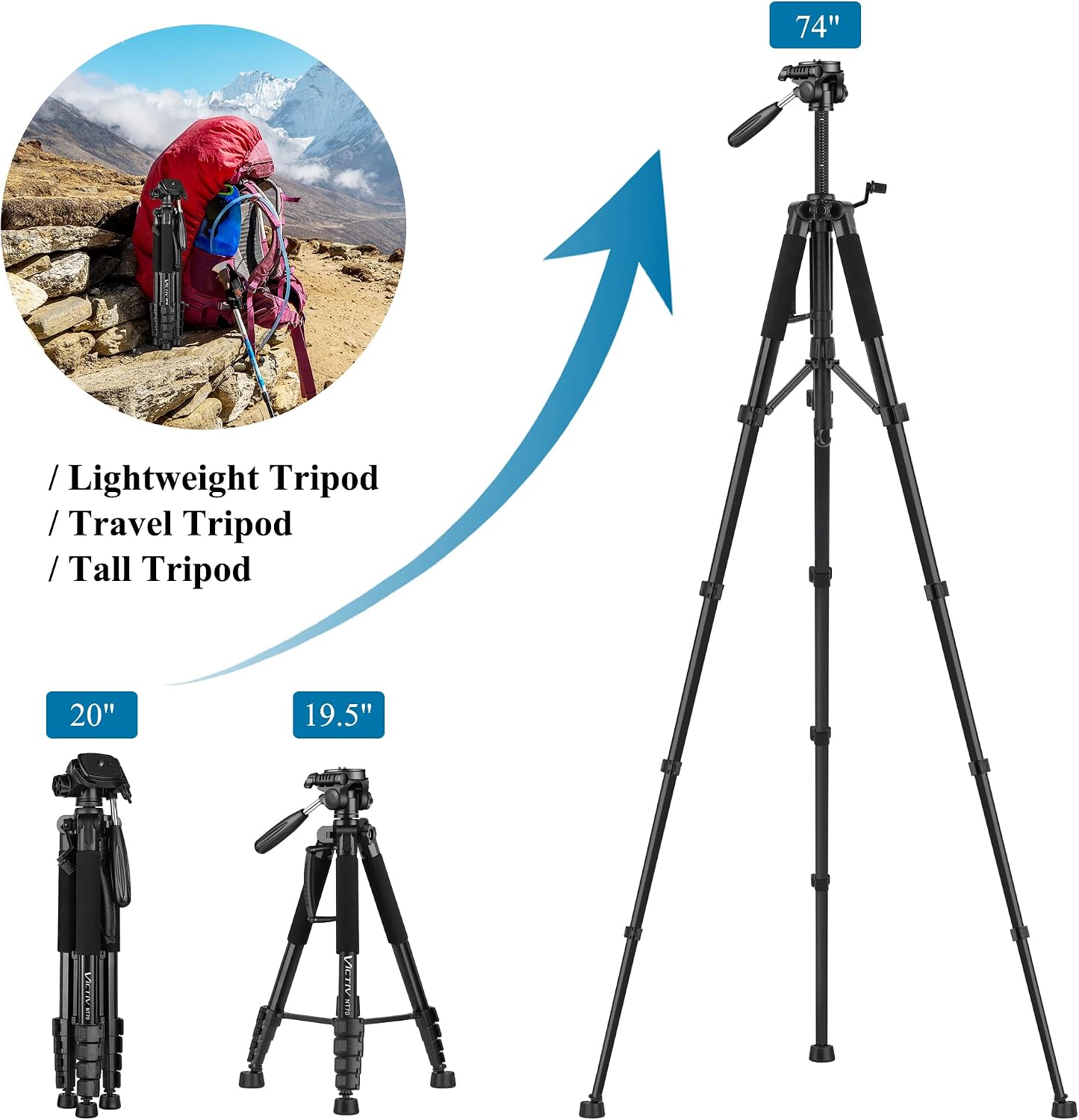
VICTIV punches above its weight in owner satisfaction, which is unusual at this price. Multiple buyers note they’d owned two or three sub-$100 tripods before the VICTIV and call it the best of that group. It ships taller than most budget competitors at 72 inches maximum height — getting the camera to eye level without extending the center column fully is a real usability win for landscape and portrait shooters.
Reviewers call out the build quality as better-than-expected: the leg tubes feel thicker, the flip locks have less play, and the included phone mount is sturdier than generic competitors. The ball head is functional but not exceptional — the consensus is that it’s adequate for stationary landscape work but introduces some drift under heavier setups. For stills-focused shooters with kits under 4 lbs, the VICTIV delivers the most consistent out-of-the-box owner satisfaction in this price bracket.
Amazon
$17.99
In stock on Amazon
Check price on AmazonCAMBOFOTO Travel Tripod
The CAMBOFOTO is the choice that travel and backpacking photographers keep recommending — its folded length and weight make it genuinely packable in a way that full-size aluminum sticks are not. Aggregated owner reviews are positive on the legs themselves, rating them stable for their weight class and appreciating the twist-lock collar design.
The stock head is where consistent criticism lands: reviewers describe it as “bulky and hard to adjust,” with panning that requires more force than it should and a locking knob positioned awkwardly. The practical consensus from experienced buyers is to treat the CAMBOFOTO as a leg purchase and budget $40–$80 for a replacement ball head immediately. The Phoblographer’s “Ball Head Upgrade Guide for Entry-Level Tripods” specifically names this type of leg-plus-upgraded-head pairing as one of the most cost-effective paths to a capable travel rig under $150 total.
Amazon
$17.99
In stock on Amazon
Check price on AmazonSmallRig CT-20
The SmallRig CT-20 sits slightly above the pure-budget tier and draws a specific buyer: video-oriented shooters who need fast deployment and a stable base. Owners consistently praise the leg section for its sturdiness and the quick-release mechanism for being genuinely fast to operate in the field.
The candid note that surfaces repeatedly: the ball-head knobs feel cheap relative to the leg build quality. Reviewers who shoot stills describe this as a minor annoyance; videographers who need precise tilt control and fluid movements find it a more meaningful limitation. For locked-down video work — static interview setups, landscape time-lapses — the CT-20 performs well. For any kind of movement or follow-focus work, a fluid head swap is strongly recommended.
VICTIV
$34.99
In stock on Amazon
Check price on AmazonThe Upgrade Question: Replace the Head or Keep It?
The Phoblographer’s “Ball Head Upgrade Guide for Entry-Level Tripods” frames this clearly: if your shooting is primarily stationary — landscapes, architecture, long-exposure cityscapes — the stock head on most budget tripods is adequate. If you’re doing portrait work with frequent reframing, product photography that needs precise positioning, or any video with manual movements, a $45–$80 ball head upgrade makes the whole rig perform like a $200 tripod.
Photography Life’s tripod-selection guide reinforces the same hierarchy: evaluate legs first, since they are the hardest and most expensive component to replace. The head is the logical first upgrade because it’s modular, and Arca-Swiss compatibility unlocks access to a broad third-party accessory ecosystem.
Upgrade priority by model:
- CAMBOFOTO: Replace the head immediately. The legs earn their price; the head does not. Nearly every experienced buyer in owner review aggregates flags this.
- K&F Concept: Replace the plastic ARCA clamp first ($20–$40). The full head is optional unless you’re using heavy glass.
- Amazon Basics: Keep the head for standard use. Plan for an adapter plate if you upgrade to an ARCA-compatible head later.
- VICTIV: Keep the head for stationary stills work. Evaluate after 90 days whether your workflow is bumping against its limits.
- SmallRig CT-20: Keep for locked-down video and stills. Budget for a fluid head upgrade if movement or precise tilt control is needed.
Frequently Asked Questions
Can these tripods handle a DSLR with a telephoto lens without wobbling?
The honest answer is: it depends on the focal length and whether you’re extending the center column. Owners report that a standard DSLR body with a 70–200mm f/4 lens (roughly 3–4 lbs combined) sits comfortably on all five models as long as the center column is kept at or below halfway extended. A heavier telephoto — 100–400mm zoom, 150–600mm — introduces enough front-heavy torque that owners report noticeable vibration, particularly on the Amazon Basics and VICTIV. Wirecutter’s “The Best Tripods” guide echoes this: for serious telephoto work, none of these are the right tool; a carbon-fiber tripod in the $200–$400 range is the appropriate next step.
Is the quick-release plate on the Amazon Basics compatible with Arca-Swiss heads?
No. The Amazon Basics uses a proprietary plate format that is not Arca-Swiss compatible. If you want to mount it to a third-party ARCA-compatible head or gimbal, you’ll need an ARCA-Swiss adapter plate and clamp, which typically runs $25–$45. This is worth planning for if you’re buying the Amazon Basics as a starter rig with intent to upgrade the head later.
Do I actually need to replace the ball head on the CAMBOFOTO or K&F out of the box?
For the CAMBOFOTO: yes, if you do any work that requires precise adjustment or frequent reframing. The leg section is solid; the head is a genuine weak point that reviewers flag consistently. For the K&F: replace the plastic ARCA clamp as a priority ($20–$40); the head mechanism itself is reasonable and the 360-degree detents work reliably. A full head replacement on the K&F is a quality-of-life upgrade, not an emergency fix.
What is the real packed length of each tripod — does it actually fit in a carry-on?
Based on aggregated owner reports and published specs: the CAMBOFOTO and K&F compact are the genuine carry-on candidates at 12–15 inches packed, fitting in the outer pockets of most 40L travel packs. The SmallRig CT-20 at 16–18 inches packed fits in a carry-on main compartment with some maneuvering. The VICTIV and Amazon Basics at 19–20 inches packed require a dedicated tripod bag or checked luggage unless you’re working with an unusually large carry-on.
Is the VICTIV phone holder sturdy enough for video recording?
Owners report that the VICTIV phone mount is sturdier than the generic clip holders included with cheaper competitors — it holds standard-sized smartphones (up to 6.5-inch screens) without slippage during stationary recording. For long recording sessions in windy outdoor conditions, owners recommend adding a small rubber grip tape wrap to the clamp jaws for additional security.
The Decision Rule
If you’re shooting stills primarily — landscapes, portraits, architecture — and your kit weighs under 4 lbs total, the VICTIV offers the best out-of-the-box experience for the money, with the most consistent owner satisfaction in its class.
If packability is your top priority and you’re willing to spend an extra $40–$80 on a replacement head, the CAMBOFOTO legs are worth that total investment.
If you’re building toward a more capable system and want ARCA-Swiss compatibility from day one, the K&F Concept with a $30 aluminum clamp swap is the most upgrade-friendly entry point.
If you shoot primarily locked-down video and need fast deployment, the SmallRig CT-20 is the right leg section — budget for a fluid head upgrade if you need any movement.
And if you’re genuinely uncertain and want the lowest-risk first tripod, the Amazon Basics continues to outperform its price tag for casual and occasional use — just don’t extend that center column all the way up.