June 13, 2026 • Declan Marsh • 12 min reading time • Prices verified June 11, 2026
Budget Tripods That Actually Hold Your Camera: Amazon Basics, VICTIV, K&F, and CAMBOFOTO Compared

A tripod is simply a three-legged stand that holds your camera steady — steady enough to shoot in low light without blur, to frame a long exposure of a waterfall, or to keep a video locked off on a talking head without the shakiness that screams “amateur.” If you’ve ever set a camera on a stack of books or asked a stranger to hold it while you run into frame, you already understand the problem a tripod solves. The question here is whether you need to spend $200-plus to solve it well, or whether the cluster of $30–$50 options flooding the market can actually do the job. Spoiler: some of them genuinely can — but not equally, and the differences matter more than the price gap suggests.
This comparison looks at five sub-$50 tripods — the Amazon Basics 60-Inch Lightweight Tripod, VICTIV 72-Inch Camera Tripod, K&F Concept 62-Inch Compact Tripod, CAMBOFOTO 67-Inch Aluminum Tripod, and SmallRig AP-01 Flexible Mini Tripod — through the lens of what actual owners report after months of use, what published specs tell us about real-world limits, and what the trade-offs look like if you’re a hobbyist, event shooter, or travel photographer trying to make a smart first or second gear purchase.
The “Soggy Noodle” Baseline Problem
Let’s name the elephant in the room: most people buying a $35 tripod expect to return it within a week. Reviewers across all five models consistently describe the same arc — they ordered with low expectations and were surprised the thing didn’t immediately collapse under a mirrorless body. That surprise says something useful, but it isn’t a green light to push these stands past their limits.
The Amazon Basics 60-Inch is the most-reviewed option in this group by a wide margin. Aggregated owner feedback clusters around two findings: it handles lightweight cameras — a Sony ZV-1, a Canon IXUS, a Fujifilm X-T30 with a kit lens — without drama, but owners loading it with full-frame DSLRs and long telephoto glass report noticeable flex in the center column and pan head. One phrase keeps appearing in long-form owner writeups: “fine for what it is.” That’s accurate, and it’s a useful compass. The Amazon Basics is a beginner’s confidence builder and a dedicated lightweight second tripod for travel. It is not a workhorse for a Sony A7 IV with a 70–200mm f/2.8 on it.
As Photography Life’s article “Tripod Head Types Explained” notes, ball head quality and design — not just raw load rating — determines how smoothly weight gets distributed across a tripod system. That distinction between a manufacturer’s rated capacity and real-world comfort is exactly why owners of the Amazon Basics with heavier rigs report flex even when technically within spec.
By the numbers — published specs at a glance:
| Tripod | Max Height | Rated Load | Collapsed Length | Weight |
|---|---|---|---|---|
| Amazon Basics 60” | 60 in / 152 cm | 6.6 lb / 3 kg | ~20 in / 51 cm | 3.1 lb |
| VICTIV 72” | 72 in / 183 cm | 11 lb / 5 kg | ~24 in / 61 cm | 3.7 lb |
| K&F Concept 62” | 62 in / 157 cm | 17.6 lb / 8 kg | ~15.7 in / 40 cm | 3.3 lb |
| CAMBOFOTO 67” | 67 in / 170 cm | 17.6 lb / 8 kg | ~17 in / 43 cm | 3.5 lb |
| SmallRig AP-01 | 20 in / 51 cm | 6.6 lb / 3 kg | ~12 in / 30 cm | 1.1 lb |
Manufacturer-rated load figures should be read conservatively — “rated for” and “comfortable with” are different things, and the difference shows up in real shooting conditions long before you reach the published limit.
The Five Contenders, Head to Head
Amazon Basics 60-Inch Lightweight Tripod
Amazon
$17.99
In stock on Amazon
Check price on AmazonThe Amazon Basics 60-Inch is the entry point of the group in every measurable way: lowest price, lowest rated load, lowest maximum height. It is also, by the sheer volume of owner experience behind it, the most thoroughly understood option here. Owners shooting with compact mirrorless bodies — Sony ZV-E10, Canon M50 Mark II, Fujifilm X-T30 — report that it handles those combinations with no drama. The pan head is basic but functional for stationary photography.
Where it shows its limits: center column flex under any camera-and-lens combination pushing past 4 pounds, a pan head that experienced shooters will find imprecise compared to a real ball head, and a maximum height that leaves taller photographers slightly stooped. Its collapsed length of roughly 20 inches means it fits in most checked luggage but is bulkier than ideal for carry-on or backpack travel.
Wirecutter’s ongoing “The Best Tripods” guide (New York Times product recommendations division) consistently flags that budget pan-head tripods tend to limit recomposing speed and precision — a trade-off that matters less for static landscape work and more for portrait and event shooting. For casual shooters with lighter bodies, the Amazon Basics delivers on its promise. For anyone planning to grow into a heavier system, it’s a short-term solution.
Amazon
$17.99
In stock on Amazon
Check price on AmazonVICTIV 72-Inch Camera Tripod
Amazon
$17.99
In stock on Amazon
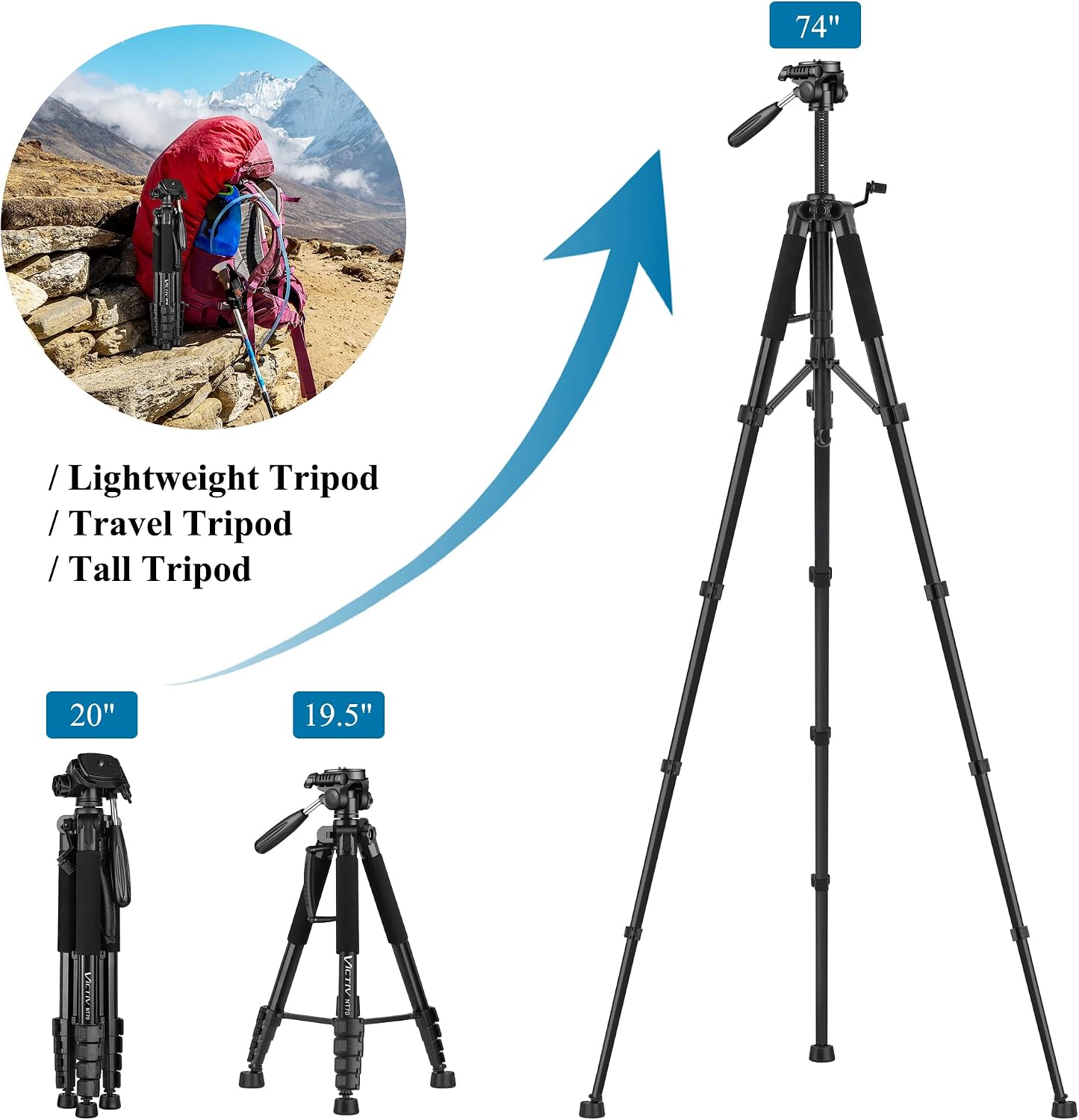
Check price on AmazonThe VICTIV 72-Inch earns its place in this group by solving the single problem that matters most to event and wedding photographers working from a full shooting day: it gets the camera to eye level without stooping. At 72 inches maximum height — roughly 6 feet — it’s the tallest option in this comparison, and for anyone who has spent a day hunched over a 60-inch tripod, that difference is genuinely physical.
Owners in sports photography and event videography call out the height advantage specifically. The 11-pound rated load gives it real headroom for a mid-weight mirrorless body with a standard zoom, and the monopod conversion feature — one leg detaches for single-leg support — adds workflow flexibility that event shooters find useful when a full tripod footprint isn’t practical. The VICTIV and CAMBOFOTO are the only two models in this comparison that offer monopod conversion; the Amazon Basics, K&F 62-Inch, and SmallRig AP-01 do not.
Its collapsed length of roughly 24 inches is the largest in the group, which matters for travel photographers — it won’t fit in a carry-on and is awkward to manage in a backpack side pocket. The VICTIV is a stay-in-the-car or check-it tripod rather than a bring-it-on-the-plane one.
VICTIV
$34.99
In stock on Amazon
Check price on AmazonK&F Concept 62-Inch Compact Tripod
VICTIV
$34.99
In stock on Amazon
Check price on AmazonThe K&F Concept 62-Inch draws the most sustained praise of any model in this group for one specific component: the ball head. In a category where pan heads dominate and feel it, K&F’s ball head offers the fluid repositioning and precise angle locking that portrait, macro, and close-up photographers depend on. Petapixel’s “Best Budget Tripods” buyer’s guide and The Phoblographer’s ongoing K&F Concept coverage both identify ball head quality as the standout characteristic of K&F’s entry-level lineup — and owners confirm it in long-form writeups.
The 17.6-pound rated load is the highest in the group alongside the CAMBOFOTO, and the 15.7-inch collapsed length is the second-shortest after the SmallRig mini — meaning it fits in more bags than any of the full-size competitors here. That combination of capable ball head, high rated load, and compact collapsed form makes it the most versatile option for photographers who want one tripod to handle multiple shooting styles and travel with them.
The one practical caveat worth naming: some owners report that the specific 62-inch model’s collapsed length — while the shortest among the full-size options — still won’t slide into a carry-on luggage pocket or a camera bag side slot. If you’re buying specifically for airline travel, measure your bag against the collapsed dimension before ordering. K&F makes multiple models with shorter profiles, and the distinction matters.
VICTIV
$34.99
In stock on Amazon
Check price on AmazonCAMBOFOTO 67-Inch Aluminum Tripod
VICTIV
$34.99
In stock on Amazon
Check price on AmazonThe CAMBOFOTO 67-Inch presents the most complicated value calculation of the group, and owners are unusually candid about it. The legs and aluminum construction draw consistent praise — it handles heavier camera-and-lens combinations well for its price, the 17.6-pound rated load is the joint highest in this comparison, and the 67-inch maximum height serves most shooting situations comfortably. Like the VICTIV, it supports monopod conversion, which expands its event and sports utility.
The problem is the included ball head, which reviewers across multiple platforms describe as mushy, imprecise, and prone to slow drift under any real load. The recommendation to replace it immediately is not a fringe opinion in owner discussions — it comes up with enough frequency and specificity to be treated as near-universal consensus among experienced shooters who’ve bought this model.
Here’s why that matters to your budget math: a competent aftermarket ball head starts around $40–$60 at the entry level. Add that to the CAMBOFOTO’s sticker price and you’re no longer in sub-$50 territory — you’re in the $80–$90 range, which puts you within reach of K&F’s mid-tier models. The CAMBOFOTO isn’t a bad tripod. The legs are genuinely solid. But the headline price hides the real cost, and you should budget for the head swap before you order rather than discovering it after delivery.
VICTIV
$34.99
In stock on Amazon
Check price on AmazonSmallRig AP-01 Flexible Mini Tripod
Amazon
$17.99
In stock on Amazon
Check price on AmazonThe SmallRig AP-01 doesn’t belong in direct competition with the tall tripods above — it’s a different tool entirely. Maxing out around 20 inches, it’s built for tabletop work, vlogging setups, product photography, and desk-mounted shooting rather than standing eye-level work. Owners who understand this before buying report high satisfaction. Owners who don’t are disappointed, and the gap in those reviews tracks almost entirely with whether the buyer matched the tool to the right use case.
SmallRig as a brand has a strong reputation in professional cinema accessories — their camera cages and mounting hardware are used by working operators — and that build quality shows in the AP-01’s metal construction and rubber-tipped flexible legs, which owners consistently praise. The weak link called out in owner writeups is the plastic locking knobs, which feel inconsistent with the otherwise solid build. For the use case it’s designed for — stabilizing a compact camera or mirrorless body on a surface for video, product work, or tabletop — it earns a recommendation. Just manage expectations on the knobs and don’t mistake it for a standing tripod.
Amazon
$17.99
In stock on Amazon
Check price on AmazonQuick-Release Plates, Monopod Conversion, and Carry Bags
Since these questions appear in virtually every owner discussion of budget tripods, here’s a direct accounting.
Quick-release plates and Arca-Swiss compatibility: None of these five tripods ships with a native Arca-Swiss plate — the dovetail standard used by most professional ball heads and L-brackets. They use proprietary or generic flat-pin plates. Wirecutter’s “The Best Tripods” guide (New York Times product recommendations division) notes this incompatibility as a reason budget tripod plates frequently get swapped out early by photographers who own Arca-Swiss compatible gear. Budget for a replacement plate — typically $10–$20 — if your other equipment uses the standard.
Monopod conversion: Of the five models, the VICTIV 72-Inch and CAMBOFOTO 67-Inch both support monopod conversion, where one leg detaches for use as a single-leg support. The Amazon Basics, K&F 62-Inch, and SmallRig AP-01 do not offer this conversion. Sports and event photographers who need to move quickly through a venue will find this feature genuinely narrows the field.
Carry bags: Owner consensus across all five models is consistent and mildly exasperated: the included bags are sized optimistically. Multiple owners report the bag will technically close around the folded tripod but requires effort, and that the handles aren’t rated for the weight of carrying it over a shoulder for a long walk. Treat the included bags as dust covers rather than genuine transport solutions. A proper tripod strap or purpose-built bag is worth the small additional investment if you’re hiking to a location.
Frequently Asked Questions
Can these tripods hold a full-frame DSLR with a heavy lens without tipping? With caution. A Canon 6D Mark II with a 24–105mm f/4 sits at roughly 3.5 pounds — within the rated limits of the K&F and CAMBOFOTO. But “rated load” assumes a level surface, fully spread legs, and the center column not extended. Owners with full-frame bodies and fast telephoto glass report that center column flex becomes noticeable on all five models under those combinations. Keep the center column down, spread the legs fully, and avoid pointing a long lens into wind.
Are the quick-release plates compatible with Arca-Swiss ball heads? No. The included plates use a different mounting standard. If you own Arca-Swiss compatible gear or plan to, budget for a replacement plate. This is typically a $10–$20 fix but it’s not optional if compatibility matters to your workflow.
Does the included carry bag actually fit the folded tripod? Technically yes; practically, it’s a tight fit owners describe as annoying. Don’t rely on it for trail hiking or travel with a heavy camera system. A dedicated tripod bag or strap is worth adding to the order.
Is the CAMBOFOTO head worth keeping or should you budget for a replacement? Based on the owner consensus pattern, budget for a replacement. The legs are the CAMBOFOTO’s genuine strength; the included ball head consistently draws criticism for imprecision and drift under load. Factor in a $40–$60 replacement head when calculating the real cost of this tripod.
Which of these tripods converts to a monopod? The VICTIV 72-Inch and the CAMBOFOTO 67-Inch both support leg-detachment monopod conversion. The Amazon Basics, K&F 62-Inch, and SmallRig AP-01 do not.
The honest summary: if you’re buying one of these for a first camera or a backup travel stand, the K&F Concept earns the top-of-list recommendation on ball head quality, build consistency, and collapsed portability. The VICTIV earns it if height and event versatility are your primary constraints. The CAMBOFOTO earns it only if you’re budgeting for a head replacement from the start. The Amazon Basics is the right tool for a lightweight compact kit and nothing heavier. And the SmallRig AP-01 is an excellent tool — for the specific job it was designed to do.