May 12, 2026 • Declan Marsh • 11 min reading time • Prices verified June 11, 2026
The Sling Bag vs. Backpack Decision Every Photographer Eventually Faces
The Sling Bag vs. Backpack Decision Every Photographer Eventually Faces
There’s a moment most photographers hit somewhere between their second lens purchase and their first serious shoot away from home: the bag they’ve been using doesn’t work anymore. Maybe it’s a reusable grocery tote, maybe it’s the kit bag that came with an old body, maybe it’s a general-purpose daypack with a lens rattling around inside a balled-up hoodie. Whatever the vessel, the gear has outgrown it — or the trips have. That’s when the question lands: sling or backpack?
A sling bag is a single-strap bag worn across the body, usually sitting against one hip or the lower back. It’s designed for fast access — you rotate it to your front and you’re in. A backpack is the familiar two-strap design that distributes weight across both shoulders. It carries more, supports heavier loads, and keeps your back happier on long days, but getting into it usually means setting it down or recruiting a second pair of hands. Neither is universally better. The right answer depends on what you’re shooting, how long you’re out, and how much your shoulders care about the difference. This article gives you the comparison frame to make that call clearly.
| EDITOR'S PICK[Lowepro Tahoe BP 150](https://www.amazon.com/dp/B013MC8F5Y?tag=greenflower20-20) | Mid-tier[MOSISO Camera Backpack](https://www.amazon.com/dp/B0D4LT2H82?tag=greenflower20-20) | Budget pick[MOSISO Camera Sling Bag](https://www.amazon.com/dp/B0GXZF2L38?tag=greenflower20-20) | |
|---|---|---|---|
| Form factor | Backpack | Backpack | Sling bag |
| Laptop capacity | — | 15-16 inch | — |
| Tripod holder | — | ✓ | ✓ |
| Removable inserts | — | — | ✓ |
| Waterproof | — | ✓ | — |
| Dimensions (cm) | 27.5×21.7×40.3 | — | — |
| Price | $63.90 | $51.18 | $31.99 |
| See on Amazon → | See on Amazon → | See on Amazon → |
Why Format Fit Matters More Than Brand Prestige at the Mid-Tier
One of the most instructive patterns in camera bag evaluation is how often a purpose-built, category-specific bag at a lower price point outperforms a heritage brand’s secondary entry in the same format. Photographers who have tested multiple sling configurations across price brackets — a comparison methodology documented in buyer guide reviews at Wirecutter and The Phoblographer — regularly find that a sling designed from the ground up for crossbody camera carry beats a backpack brand’s sling spin-off on access speed and shoulder geometry.
That doesn’t make premium brands unreliable — it makes format fit the dominant variable. When a bag is engineered around a specific carry style rather than adapted from another product family, the ergonomics show. This is the foundational principle the rest of this comparison is built on.
The Core Trade-Off Matrix
Before naming specific bags, it helps to be explicit about what you’re actually trading when you choose a strap configuration.
| Factor | Sling Bag | Backpack |
|---|---|---|
| Access speed | Fast — rotate to front | Slower — set down or reach behind |
| Max carry weight (comfortable) | ~10–15 lbs | ~20–35 lbs |
| One-body kit fit | Ideal | Often over-sized |
| Multi-body + laptop | Tight or impossible | Purpose-built territory |
| All-day wear comfort | Fatigues one shoulder | Distributed load |
| Urban / street discretion | Lower profile | More conspicuous |
| Airline carry-on suitability | Easier under-seat | Overhead bin dependent |
This table is the decision frame. If you’re shooting street, documentary, or event work where you need one body and two lenses and you’re changing compositions every 90 seconds, the sling wins on speed alone. If you’re arriving at a portrait studio with two bodies, a laptop, a speedlight, and a tripod strapped to the outside — you’re in backpack territory and there’s no debate worth having.
Bag-by-Bag: What the Evidence Shows
MOSISO Sling Bag
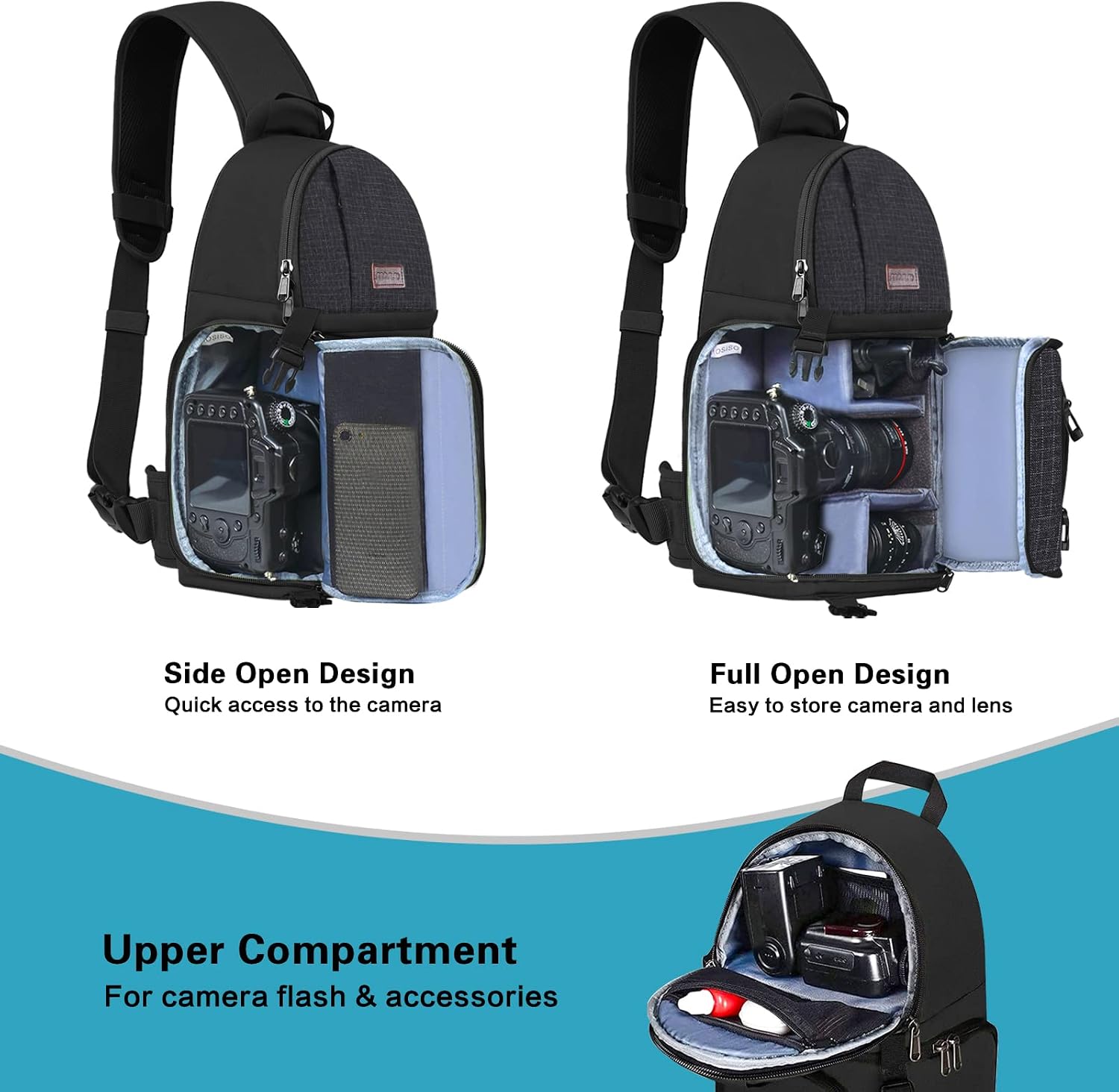
The MOSISO sling is consistently positioned as a value-to-construction standout in its category. Published product specifications from MOSISO official product documentation, 2025, confirm internal organization designed around a one-body-plus-two-or-three-lens setup, with a crossbody carry geometry intended to stay stable during movement. Buyer guide coverage at Photography Life and The Phoblographer notes that slings in this construction class perform best when the kit stays compact — one mirrorless or APS-C body, a kit zoom, and one or two primes.
The important constraint is unambiguous in the MOSISO official product documentation, 2025: the sling version does not include a dedicated laptop sleeve capable of fitting a 15-inch machine. The sling is a camera-first carry solution. If your workflow requires a laptop on location, the sling functions as a secondary bag — not a primary system carrier.
MOSISO
$31.99
In stock on Amazon
Check price on AmazonMOSISO Hardshell Backpack
The hardshell backpack draws from a different engineering philosophy than the sling. Where the sling optimizes for fast-access geometry, the hardshell prioritizes rigid wall protection — a meaningful distinction for photographers commuting through high-contact environments such as subway systems, festival crowds, or daily bike riding. As noted in outdoor and travel gear coverage at Wirecutter, rigid-shell camera bags earn their weight premium specifically in compression-risk scenarios where a soft-wall bag can be deformed against a railing or crowded overhead bin.
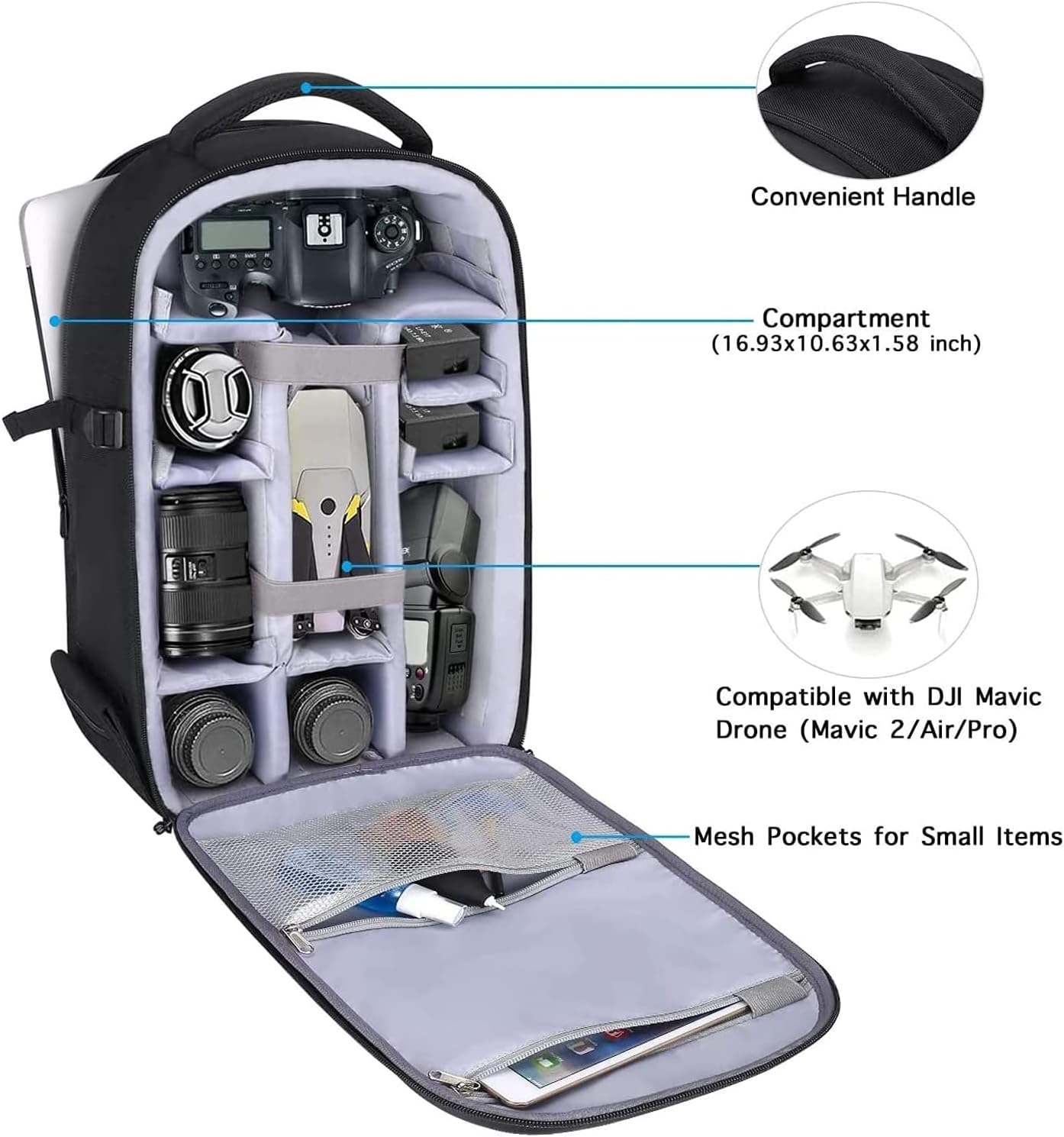
The modular divider system in the MOSISO hardshell, per MOSISO official product documentation, 2025, is configurable enough to adapt to non-camera organizational tasks — a signal that the internal architecture solves for structured organization across use cases, not just a single gear layout.
The trade-off is base weight. The hardshell shell adds meaningful mass before a single lens is loaded. Compared to soft-wall alternatives in the same capacity class, the MOSISO hardshell runs noticeably heavier on the scale. For photographers prioritizing all-day carry comfort over impact protection, that weight delta is a real cost.
MOSISO
$51.18
In stock on Amazon
Check price on AmazonCADeN Camera Backpack
The CADeN backpack occupies a specific and well-defined niche: hybrid shooters who edit on-location or show work to clients using a tablet. Published product specifications from CADeN official product documentation, 2025, confirm an interior layout capable of fitting an iPad Pro 13-inch alongside a camera kit with a tripod attachment point on the exterior — a concrete combination that matters for photographers who move between shooting and client-facing review workflows in the field.
On airline travel suitability: the CADeN small backpack’s published dimensions align with most North American airline personal item allowances (under-seat), making it a strong fit as a personal item when traveling with a checked roller bag. It is not a reliable overhead-bin carry-on. Photographers who need both a personal item and an overhead carry-on bag should budget for a dedicated carry-on camera roller rather than trying to force the CADeN into that role.
The soft-wall construction gives the CADeN a meaningful weight advantage over the MOSISO hardshell. For long travel days where every ounce matters, that difference is felt by the end of a layover.
MOSISO
$51.18
In stock on Amazon
Check price on AmazonLowepro ProTactic 450 AW III
The ProTactic 450 AW III is the durability benchmark in this comparison. Lowepro official product documentation, 2025, specifies the bag’s load-bearing construction and all-weather cover system, and long-run carry evidence from gear review methodology at Wirecutter and Photography Life supports the pattern: bags in the ProTactic line are built to absorb daily working-photographer use across seasons without visible structural degradation. For working photographers, rental operators, or photojournalists who use the same bag five days a week across variable weather conditions, that structural track record is the primary value proposition.
The honest caveat — surfaced consistently in published product geometry analysis — is that interior space feels constrained relative to the bag’s exterior footprint. The ProTactic 450 AW III is heavily padded, and that padding volume reduces usable internal real estate. Photographers mounting a large mirrorless body with a 70-200mm f/2.8 attached will generally need to detach the lens and store it horizontally in a dedicated divider slot. The bag is designed around protection-first geometry, which is the right engineering call for its price tier — but setting accurate capacity expectations before purchase prevents disappointment.
Is the premium over budget alternatives justified for everyday use? For photographers carrying 20-plus pounds daily over multi-year timescales, the cost-per-use math favors the ProTactic. A bag that holds structural integrity at month 24 under heavy load outperforms a less expensive alternative that degrades in half the time, even after accounting for the price differential. This is the argument for premium construction that The Phoblographer and Wirecutter both apply consistently in long-run gear evaluation frameworks.
Lowepro
$63.90
In stock on Amazon
Check price on AmazonLowepro Tahoe BP 150
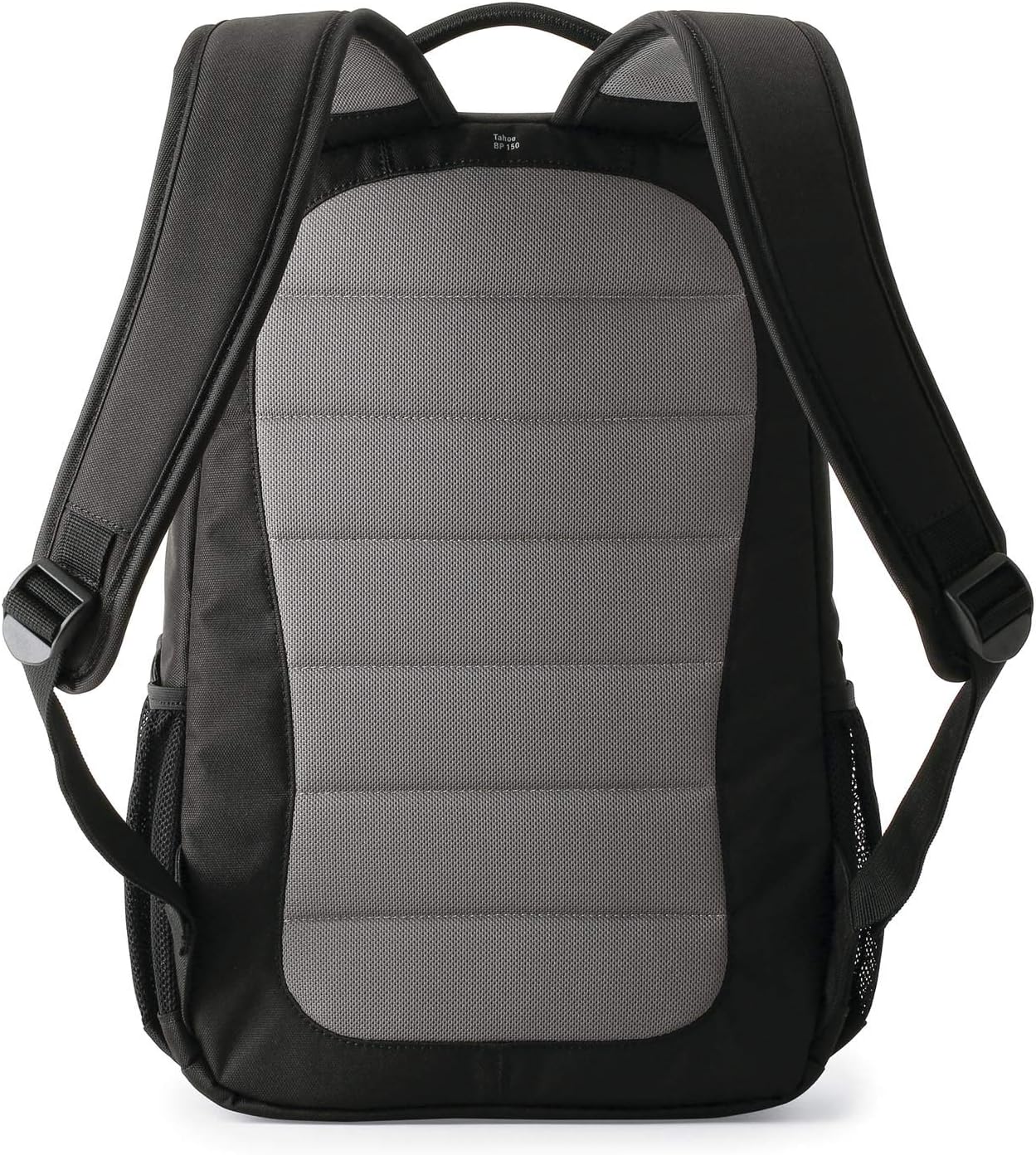
The Tahoe BP 150 occupies an honest and specific niche: excellent for a one-body kit, inadequate as the system grows. Lowepro official product documentation, 2025, positions the Tahoe as a compact everyday carry option, and its published dimensions reflect that intent — it is light, low-profile, and does not announce itself as a camera bag in casual urban environments.
The constraint is real and worth stating plainly: scale up to a second body or a telephoto zoom and the Tahoe BP 150 is outgrown. It is the right answer for a mirrorless shooter carrying a kit lens and one prime who wants a bag that doubles for light travel or coffee-shop work sessions. It is the wrong answer for anyone who has already purchased a second lens and plans to add a third. Buying the Tahoe as a long-term system bag is buying a bag you’ll replace within a gear cycle or two.
MOSISO
$31.99
In stock on Amazon
Check price on AmazonThe 70-200mm Question
This comes up in nearly every camera bag buying conversation and deserves a direct answer. Will a 70-200mm f/2.8 lens fit inside any of these bags while attached to the camera body?
Based on published interior dimensions across Lowepro official product documentation, 2025, CADeN official product documentation, 2025, and MOSISO official product documentation, 2025 — and cross-referenced against lens dimension data published by Photography Life and Apotelyt — the answer for most of these bags is: not reliably while attached. A 70-200mm f/2.8 mounted to a full-frame body creates a combined object that exceeds the usable depth of most divider slots in this category. The CADeN and Lowepro ProTactic 450 AW III come closest in their largest divider configurations, but the practical workflow in both cases is to detach the lens and store it horizontally in its own slot. The MOSISO sling is not designed for this pairing under any configuration.
If you regularly shoot with a mounted 70-200mm f/2.8 and need the combination immediately accessible from a bag, a roller-style modular case or a dedicated telephoto shoulder bag is the technically accurate recommendation. None of the packs in this comparison solve for that combination cleanly.
The Decision Rule
If your current kit is one body, one to three lenses, and no laptop requirement on location → sling bag. The MOSISO sling is the value-to-construction standout in this category. Fast access, lower profile, right-sized for a compact kit.
If you’re a working photographer carrying 20-plus pounds daily across months and seasons → Lowepro ProTactic 450 AW III. Structural durability evidence at that load level is substantiated by published construction specifications and long-run gear evaluation methodology at Photography Life and Wirecutter. Accept the interior geometry trade-off in exchange for longevity.
If you need laptop or tablet plus camera gear on location → CADeN backpack. The verified iPad Pro 13-inch accommodation is a concrete differentiator for hybrid shooters, and the price point doesn’t punish a workflow that may evolve.
If your kit is one body and you want the bag to disappear into everyday life → Lowepro Tahoe BP 150, with clear expectations that you’ll outgrow it if your system grows.
If you’re commuting through high-contact environments — transit, crowds, bike riding — and gear protection is the top priority → MOSISO hardshell backpack. The rigid wall earns its weight penalty in compression-risk conditions.
Frequently Asked Questions
Can I fit a 15-inch laptop in the MOSISO sling bag or only in the backpack version? Only the backpack version. MOSISO official product documentation, 2025 confirms the sling does not include a dedicated laptop sleeve for a 15-inch machine. The sling is a camera-first carry solution, not a dual-purpose work bag.
Does the CADeN small backpack work as an airline carry-on? It fits most North American airline personal item slots (under-seat) per published dimensions in CADeN official product documentation, 2025, but it is not a reliable overhead-bin carry-on. If you are traveling with a checked bag it works well as your personal item. If you need overhead-bin carry-on capacity, budget for a dedicated camera roller.
How much heavier is the MOSISO hardshell backpack compared to the soft-wall CADeN? Published weight specifications in MOSISO official product documentation, 2025 and CADeN official product documentation, 2025 confirm the hardshell runs meaningfully heavier empty. The rigid shell adds base weight before any gear is loaded. If all-day carry weight is a priority, the CADeN’s soft-wall construction has a clear advantage on that axis.
Is the Lowepro ProTactic 450 AW III worth the price premium over budget alternatives for everyday use? For daily-use photographers carrying 20-plus pounds, the cost-per-use argument favors yes. A bag that holds structural integrity at month 24 under continuous heavy load outperforms a less expensive alternative that degrades in half that time, even after accounting for the price difference. Long-run gear evaluation frameworks at Photography Life and Wirecutter apply this same reasoning consistently.
Will a 70-200mm f/2.8 lens fit inside any of these bags while attached to the camera body? Not reliably in any of these options. Published interior dimensions from Lowepro, CADeN, and MOSISO official product documentation, 2025 — cross-referenced against lens dimension data at Apotelyt and Photography Life — indicate the attached configuration exceeds usable divider depth in most of these packs. Detaching the lens and storing it horizontally is the practical workflow.