May 11, 2026 • Declan Marsh • 11 min reading time • Prices verified June 11, 2026
CPL Filters for Every Budget: K&F, Hoya, NEEWER, and NiSi Tested by Real Owners

A CPL filter — short for circular polarizing lens filter — is a piece of optical glass that screws onto the front of your lens and, when rotated, cuts reflected light from water, glass, foliage, and sky. The practical result: water turns from a pale mirror into a window you can see through, skies deepen from washed-out blue to the kind of saturated contrast that used to require heavy Lightroom work, and haze on distant landscapes pulls back noticeably. It is one of the few accessories whose effect is genuinely difficult to replicate in post-processing, which is why photographers across every budget tend to have a strong reaction the first time they rotate one on-lens and watch the scene transform in the viewfinder. This article compares four of the most commonly purchased CPL brands — K&F Concept, Hoya, NEEWER, and NiSi — across the $15–$90 price corridor, drawing on aggregated owner reports, published editorial reviews, and spec-sheet comparisons so you can make a clean decision before you buy.
| EDITOR'S PICK[Hoya NXT Plus 49mm Polarizing F](https://www.amazon.com/dp/B07D6Z52ZQ?tag=greenflower20-20)… | Mid-tierK&F Concept 55mm UV/CPL/ND Lens… | Budget pickK&F CONCEPT 58mm Circular Polar… | |
|---|---|---|---|
| Filter Type | Polarizing | 3-Piece Kit | Circular Polarizer |
| Coatings | 10-Layer HMC | 18 Multi-Layer | 18 Multi-Coated |
| Frame Type | Low-Profile Alum. | — | Ultra-Slim |
| Included Acc. | — | Pouch + Cloth | Cleaning Cloth |
| Size | 49mm | 55mm | 58mm |
| Price | $53.90 | $36.99 | $15.99 |
| See on Amazon → | See on Amazon → | See on Amazon → |
The Moment That Sells Every CPL: What Owners Actually Experience
The before/after transformation a circular polarizer delivers on water and sky is widely described by photography educators as one of the single most dramatic quality improvements a photographer can add without changing their camera or lens. Photographylife.com, in their guide “How to Use a Circular Polarizer Filter,” notes that the effect is essentially irreversible in post-processing. Blown highlights from reflections are gone permanently; a CPL prevents the problem before it reaches your sensor. You cannot recover polarized light in Lightroom after the fact, which is what separates the CPL from almost every other filter type.
What owners describe across the board is a two-phase experience. Phase one is the first rotation outdoors — usually genuine disbelief that such a visible change is happening in real time. Phase two, which surfaces in reviews six and twelve months later, is the more measured verdict: does the filter hold up, does it introduce color shifts, and was the price point the right call? That second phase is where the brand differences become concrete, and it is the organizing logic of everything below.
Brand by Brand: What Owners Consistently Report
K&F Concept: The Kit-Friendly Entry Point
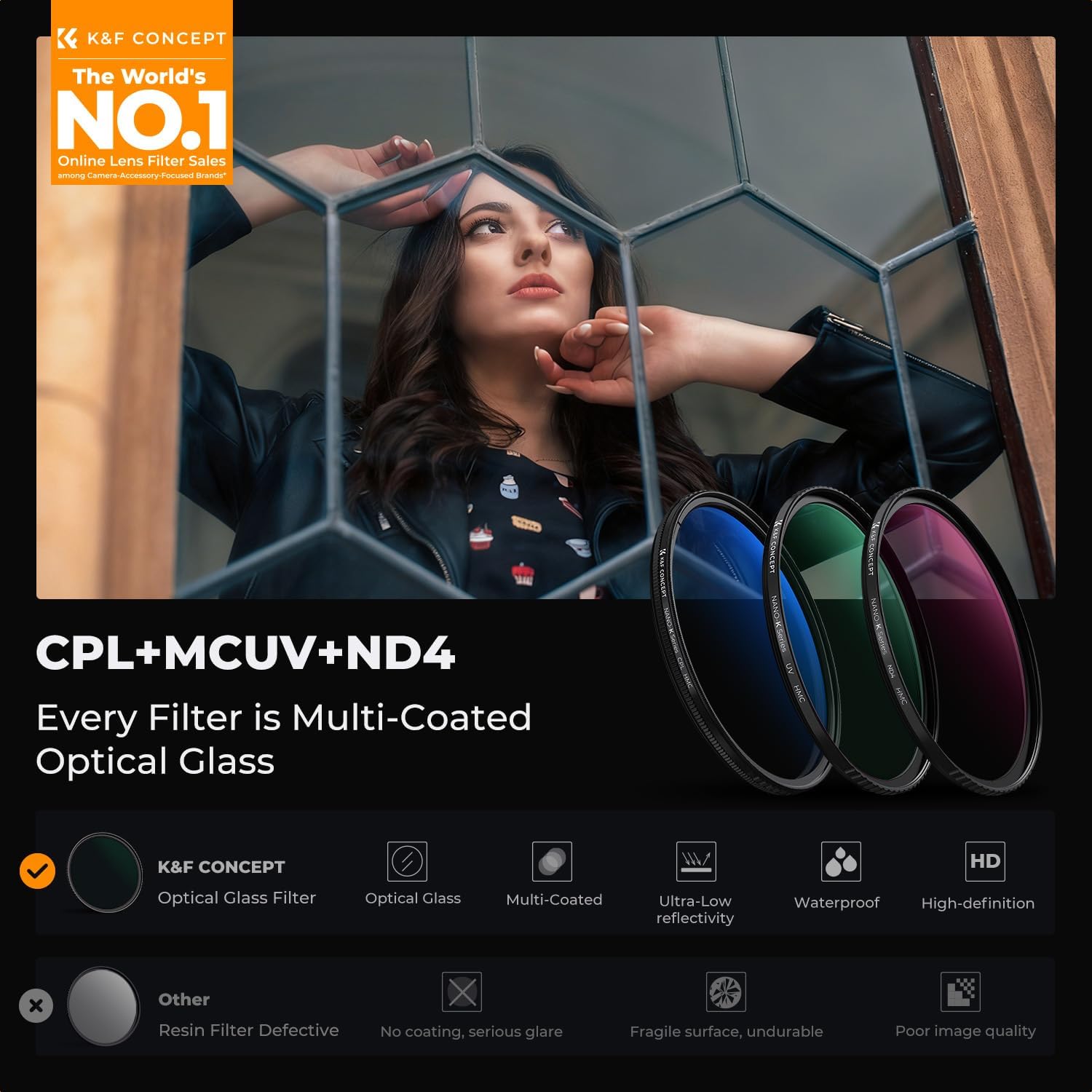
K&F’s CPL filters sell in both individual and three-filter kit form (UV + CPL + ND). Owners who purchased the three-filter kit consistently describe a predictable usage pattern: the UV filter stays on the lens as everyday protection, the CPL comes out for landscapes and bright-sun shooting, and the ND gets used for slow-shutter or video work. Petapixel, in their roundup “Best CPL Filters: Our Top Picks for Every Budget,” notes that K&F has built a reputation for usable optical quality at a price point that makes sense for someone still deciding how seriously they want to pursue filter work.
One owner use case worth highlighting: a photographer who bought the K&F CPL specifically for a Nikkor 200-500mm telephoto. That lens takes a 95mm filter thread — a size where premium CPL prices scale up quickly. At 95mm, a NiSi or B+W CPL can run $130–$180; the K&F equivalent sits under $40. The owner’s report: competent polarization effect, no deal-breaking color shift, though the rotation action felt less smooth than higher-end options. For a large-format telephoto that lives in a bag and comes out for specific shots, the math strongly favors the budget option.
Approximate pricing (77mm reference size):
- K&F Concept CPL (77mm): approximately $18–$25
- K&F 3-filter kit (UV + CPL + ND, 77mm): approximately $28–$38
K&F
$15.99
In stock on Amazon
Check price on AmazonHoya NXT Plus: The Sweet Spot That Most Reviews Land On
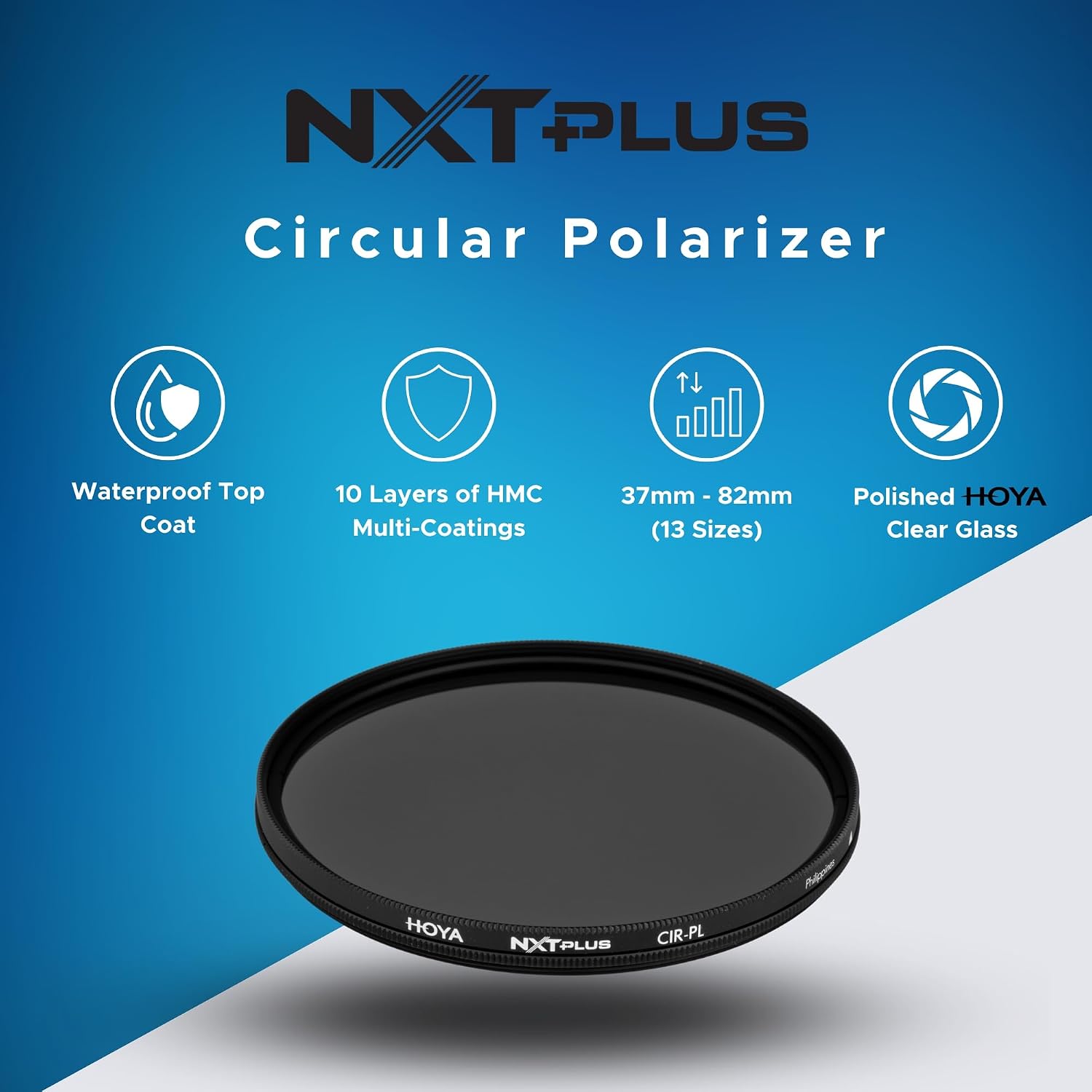
Hoya is the brand that dominates “best mid-range CPL” recommendations consistently, and for well-documented reasons. Outdoorphotographer.com’s editorial piece “Polarizing Filters: Which One Is Right for You?” names Hoya as a benchmark for mid-tier optical quality, and the pattern in long-run owner reviews supports that assessment. The NXT Plus line uses multi-coated glass that owners describe as neutral in color rendering — no yellow cast, no green shift — which is the key differentiator from uncoated or single-coated budget options.
The emotional reaction that shows up repeatedly in Hoya NXT Plus reviews — owners describing the first outdoor use as a revelation — is often not a reaction to using a CPL for the first time, but to upgrading from an unbranded budget CPL to the Hoya. The difference between a cheap single-coated filter and a properly multi-coated mid-tier option is visible enough to prompt that response. For anyone currently using an off-brand filter and wondering if an upgrade is worth it, the aggregated owner evidence says yes.
Hoya’s build quality — specifically the rotation ring — receives consistent positive mentions. Smooth, well-damped rotation matters in practice because you are making fine adjustments while watching the viewfinder or live view, and a notchy or stiff ring makes that harder.
Approximate pricing (77mm reference size):
- Hoya NXT Plus CPL (77mm): approximately $35–$50
K&F ND4
$36.99
In stock on Amazon
Check price on AmazonNEEWER: The Filter-as-Insurance Argument
NEEWER occupies the lowest price tier in this comparison, and the most compelling real-world report from that camp is also one of the most practical arguments in all of filter photography: an owner described a NEEWER filter cracking and shattering on impact while the lens thread it was protecting survived undamaged. The filter absorbed the hit; the lens lived.
This is the filter-as-insurance use case, and it applies across brands but hits hardest at the budget level. Lensrentals.com, in their commentary on filter quality and optical coatings, notes that front-element damage is a common repair line item and that a sacrificial filter is a legitimate protective strategy even if the filter itself offers modest optical improvement over shooting bare glass. A $15 NEEWER CPL that saves a $600 lens front element from a drop has a return on investment that needs no further explanation.
The honest optical verdict on NEEWER from aggregated reviews: the polarization effect is real and functional, but owners report higher variability in color neutrality. Some units introduce a faint warm cast; others do not. Quality control is less consistent than Hoya or NiSi. For pure lens protection and basic polarization, NEEWER earns its place. For critical landscape or product work where color accuracy matters, the variability is a meaningful risk.
Approximate pricing (77mm reference size):
- NEEWER CPL (77mm): approximately $12–$18
K&F
$15.99
In stock on Amazon
Check price on AmazonNiSi: The Color-Accuracy Argument, and a Practical Warning
NiSi occupies the premium end of this comparison’s price range, and the owner reviews that stand out are the ones documenting direct brand switches. Multiple reviewers describe returning a competing CPL specifically because of a persistent yellow or warm color cast that required correction in post, then purchasing the NiSi to resolve it. Thephoblographer.com, in their hands-on review of NiSi’s filter lineup, identifies NiSi’s multi-coating process as a genuine optical differentiator in color neutrality — a conclusion consistent with what long-run owner reports describe.
The practical warning that most CPL articles skip: NiSi CPL filters have a wider rotating ring profile than most competing brands. That extra width creates clearance problems with deep lens hoods. Multiple owners flag that the NiSi ring is too wide to clear certain petal hoods, requiring hood removal before the CPL can be installed and rotated to position. This is not a dealbreaker, but it is a real workflow friction point that Hoya and K&F users generally do not face. If you shoot primarily with a hood attached — which is good practice for flare control — factor that into your decision and plan for the extra step.
Approximate pricing (77mm reference size):
- NiSi CPL (77mm): approximately $75–$90
Hoya
$53.90
In stock on Amazon
Check price on AmazonMatching Filter Diameter to Your Lens: The Step-Up Ring Question
Filter diameter is measured in millimeters and corresponds to the front thread diameter of your lens, not the focal length or aperture. The number is printed on the lens barrel, usually preceded by a ⌀ symbol, and appears in every manufacturer’s lens specification sheet. Common sizes run from 49mm on compact primes to 82mm or 95mm on large telephoto and zoom lenses.
If you own multiple lenses with different front diameters, the most cost-efficient approach is to buy your CPL at the largest diameter you own and use step-up rings — inexpensive metal adapters — to fit it on smaller lenses. A 77mm CPL with a 58mm-to-77mm step-up ring costs less than buying two separate filters. The tradeoff: a physically larger filter on a smaller lens can vignette at very wide focal lengths and makes the kit bulkier. For primes in the 35mm–85mm range, buying the correct size is typically cleaner.
The K&F example at 95mm illustrates the scale problem well: at large thread diameters, premium filter costs escalate sharply, which makes the value calculation for budget filters more favorable even for photographers who would otherwise choose Hoya or NiSi at standard sizes.
Frequently Asked Questions
Will a budget CPL introduce a color cast into my photos?
It is a real risk at the lowest price tier. Owner reports on NEEWER and generic unbranded CPLs describe occasional warm or yellow casts that require post-processing correction. Hoya NXT Plus and NiSi consistently receive neutral color rendering reports from owners across long review periods. The direct brand-switch stories — owners returning a competitor’s filter specifically over color cast — are the clearest evidence that color neutrality varies meaningfully by price and build quality. If accurate color matters to your workflow, budget at least to the Hoya NXT Plus tier.
How do I find the right filter diameter for my lens?
Check the lens barrel for a number preceded by the ⌀ symbol, or look up your lens in its manufacturer specification sheet. Common examples: Canon 50mm f/1.8 STM uses 49mm; Canon 24-105mm f/4L uses 77mm; Nikon 70-200mm f/2.8 uses 77mm; Nikkor 200-500mm f/5.6 uses 95mm. When in doubt, the diameter is often printed on the inside of the lens cap as well.
Can I use a CPL with my lens hood attached?
Usually yes, but with a caveat. CPLs require rotation after mounting, and deep petal hoods can obstruct finger access to the filter ring. The NiSi CPL’s wider ring profile makes this problem more acute — multiple owners specifically flag hood incompatibility with certain Canon and Nikon petal hoods. Hoya and K&F’s slimmer profiles are generally easier to rotate through or around a hood. For critical outdoor work where you want both flare control and polarization, you may need to remove the hood, rotate the CPL to the optimal position, then reattach the hood.
Is a CPL or UV filter more important to buy first?
For optical benefit, the CPL wins decisively. A UV filter on a modern digital camera provides minimal image quality improvement — digital sensors do not respond to UV the way film did. Its value today is primarily as a scratch and dust barrier for the front element. A CPL, by contrast, delivers a visible optical improvement that cannot be replicated in post-processing. The K&F three-filter kit framing — UV as daily protection, CPL for active shooting — is a reasonable mental model, but if budget forces a single choice, buy the CPL first.
Does a CPL work for video?
Yes, and it is arguably more valuable for video than for stills because reflections and blown sky cannot be corrected in color grading the way they can be partially addressed in Lightroom. The rotation behavior is identical to still use. In practice, videographers typically set the CPL to the optimal rotation before rolling, then leave it fixed. Outdoorphotographer.com’s polarizing filter guide “Polarizing Filters: Which One Is Right for You?” notes that videographers covering outdoor events, real estate walkthroughs, and automotive work regularly rely on CPLs to manage window reflections and sky exposure. There is no image-quality penalty for video use; the filter works the same optically regardless of capture format.
The Decision Rule
If you want basic polarization and lens protection on a tight budget: K&F’s three-filter kit gives you UV, CPL, and ND for under $40 at most common sizes. Expect functional results and accept some variability in build smoothness. Ideal for a first-time CPL buyer or a large-diameter telephoto where premium prices are hard to justify.
If you want neutral color and reliable rotation without paying premium prices: Hoya NXT Plus is where the mid-tier recommendation consistently lands — across Petapixel’s buyer guides “Best CPL Filters: Our Top Picks for Every Budget,” Outdoorphotographer.com’s editorial coverage, and long-run owner reviews. For most photographers shopping in the $35–$50 range per filter, this is the right answer.
If color accuracy is non-negotiable — portrait work, product photography, landscape work destined for print: NiSi earns its price premium on color neutrality, as documented in Thephoblographer.com’s hands-on review of their filter line. Budget for the hood-clearance workflow step and you will have the most optically transparent CPL at this price tier.
If the filter is primarily serving as sacrificial front-element protection: NEEWER at $15 is a legitimate choice. The broken-filter-saved-the-lens outcome is not a fluke — it is exactly what a sacrificial filter is designed to do, and at this price point the replacement cost is trivial.