June 25, 2026 • Declan Marsh • 10 min reading time • Prices verified June 11, 2026
Sony Full-Frame Lenses Under $500: The 50mm f/1.8 and Tamron Zooms Compared
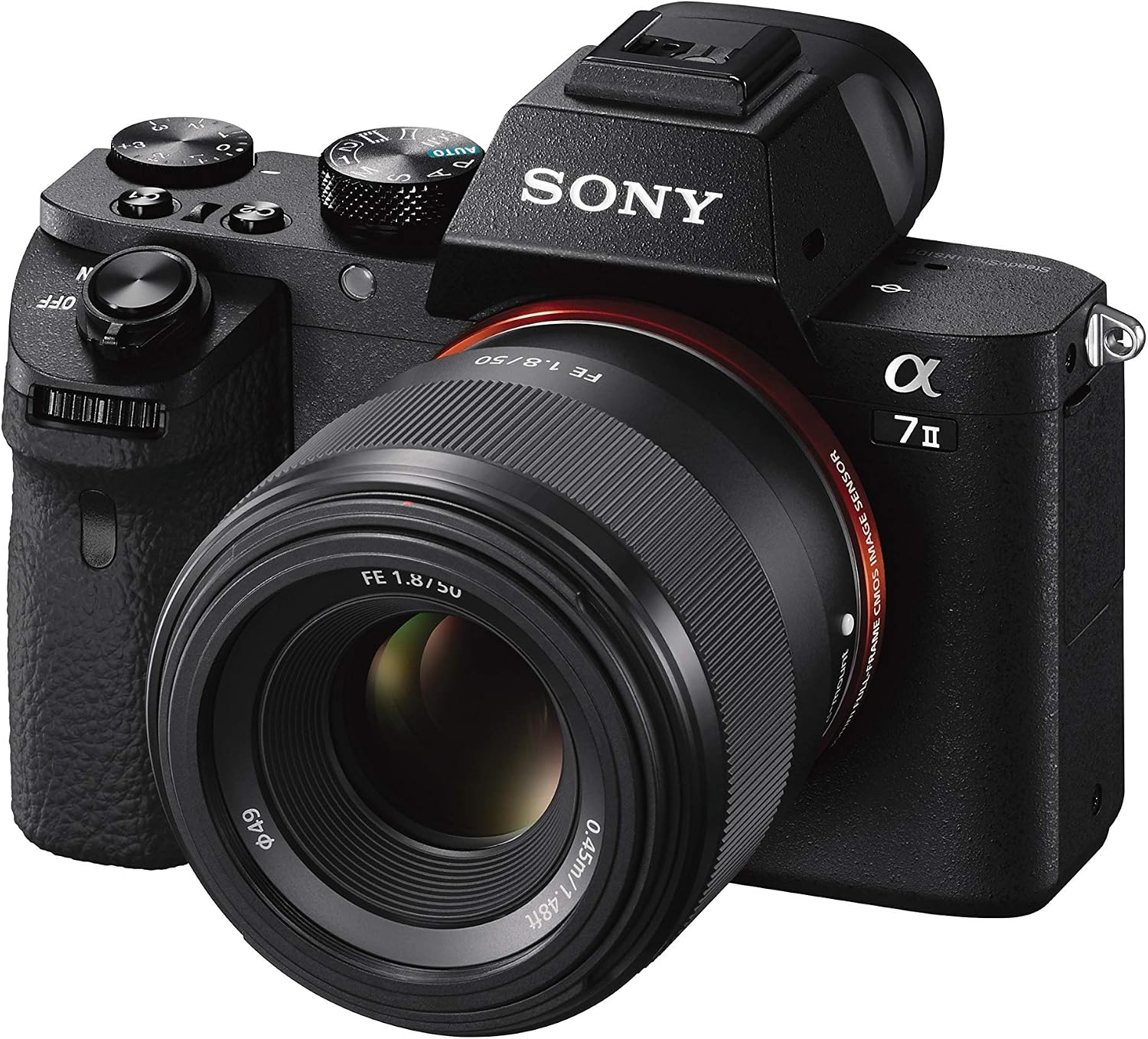
If you’re shopping for a Sony full-frame camera lens and your budget caps out around $500, you’re in genuinely good territory — better than this price range had any right to be five years ago. A quick note on terms: “full-frame” means the camera sensor is the same size as a traditional 35mm film frame, which gives you better low-light performance and shallower depth of field (that blurry background look) compared to smaller sensors. “f/1.8” and “f/2.8” refer to how wide the lens aperture — the opening that lets in light — can get. Lower numbers mean more light and more background blur. With that grounding in place: this article compares three lenses that together cover the most common shooting situations Sony E-mount owners actually face, with real street prices as of May 2026 and decision-ready trade-off framing for each one.
The three contenders are the Sony FE 50mm f/1.8 (around $200–$220 new), the Tamron 28-75mm f/2.8 Di III VXD G2 (street price roughly $679 new, but frequently found used on MPB or KEH Camera in the $400–$470 range), and the Tamron 70-180mm f/2.8 Di III VXD G2 (new around $749, used closer to $500–$530). The last two are technically a few dollars above the $500 new threshold — but used pricing puts both within reach, and the article would be dishonest not to include them when the used math works.
The Sony FE 50mm f/1.8: When “Punches Above Its Weight” Is Actually True
The phrase “punches above its weight” gets applied to budget lenses so reflexively it’s nearly meaningless. In this case, reviewers keep reaching for it because it’s accurate in a specific, verifiable way: the optical performance the Sony 50mm f/1.8 delivers at roughly $210 sits comfortably in territory that Sony’s own 50mm f/1.4 Zeiss-branded option commanded at four times the price.
DPReview’s Sony FE 50mm f/1.8 lens review describes center sharpness as genuinely strong wide open — not “acceptable for the price” but strong — with corner performance that improves meaningfully by f/2.8. Chromatic aberration (color fringing along high-contrast edges) is present but well-controlled. Across aggregated owner reviews, the pattern is consistent: this lens earns its living in portrait and low-light work, the two use cases where a fast prime (a lens with a fixed focal length and wide maximum aperture) justifies its existence.
What owners consistently report: pleasing background separation at f/1.8 that makes subjects pop without requiring any post-processing, fast and quiet autofocus that handles moving subjects reliably on bodies like the a7 IV and a7C, and a physical form factor that makes the camera feel balanced rather than front-heavy.
The honest downsides: the build is polycarbonate — it feels like what it costs. There’s no weather sealing, which matters if you’re shooting events in unpredictable conditions. Bokeh (the quality of the out-of-focus areas) has a slightly busy character in some situations that more expensive portrait primes handle more smoothly. And at 50mm on a full-frame body, you’re working at a focal length that requires deliberate positioning — you need to be roughly 6–10 feet from a subject for a flattering head-and-shoulders frame.
The professional-use question is real and worth answering directly here: The Phoblographer’s coverage of budget Sony glass consistently positions this lens as a capable professional tool in the right context. For environmental portraits, lifestyle editorial, and low-light reception photography, it competes. Where it doesn’t compete is in demanding conditions — heavy rain, the need for consistent corner-to-corner uniformity across hundreds of frames, or situations where clients are watching you work and build quality is part of the pitch.
Tamron 28-75mm f/2.8 G2: The One That Earns “Go-To” Status
The Tamron 28-75mm f/2.8 Di III VXD G2 is the version of this lens that fixed the autofocus complaints about the original G1. That matters enough to repeat: if you’re looking at used inventory, confirm you’re buying the G2, identifiable by the VXD (Voice-coil eXtreme-torque Drive) motor designation on the barrel.
The range this lens covers — 28mm to 75mm — is the range where most photographers live. Wide enough for environmental context at 28mm, close enough to compress a portrait at 75mm. The constant f/2.8 aperture means your exposure doesn’t shift as you zoom, which is not true of the Sony 28-70mm kit zoom that ships with many a7-series bodies (that lens is f/3.5 at the wide end and f/5.6 at 70mm — a meaningful difference in low-light situations).
Photography Life’s Tamron 28-75mm G2 review rates sharpness as excellent from the center and very good at the edges by f/4, with performance wide open at f/2.8 that’s genuinely usable rather than just technically functional. Lensrentals’ optical bench data on the Tamron 28-75mm G2 showed strong sample-to-sample consistency — a detail that matters if you’re buying used and can’t physically inspect the lens before purchase.
The reviewer who described this as his “go-to for most situations” after a year of regular use on the Sony a7 series is worth taking seriously precisely because the one-year mark is where honeymoon enthusiasm has faded. His only sustained complaint was weight: the lens is 540 grams (just under 1.2 pounds), and on an all-day shoot it accumulates. His workaround — using a monopod as a walking stick between setups — is the kind of practical adaptation that tells you the fatigue is real but manageable. Event photographers and wedding shooters considering this lens should factor that in before dismissing it.
By the numbers — Tamron 28-75mm G2 vs. Sony 28-70mm kit zoom:
| Tamron 28-75 G2 | Sony 28-70mm Kit | |
|---|---|---|
| Max aperture | f/2.8 constant | f/3.5–5.6 variable |
| Weight | 540g | 295g |
| New price (May 2026) | ~$679 | ~$200 standalone |
| Used/MPB price | ~$420–$470 | ~$110–$140 |
The aperture advantage is two to three stops — a meaningful difference for ambient-light event work.
Tamron 70-180mm f/2.8 G2: The Upgrade That Street Photographers Are Finding
The Tamron 70-180mm f/2.8 Di III VXD G2 sits in a niche that sounds narrow on paper — a telephoto zoom covering subjects at medium-to-long distance — but turns out to be exactly what a lot of shooters are missing in their kit. Portrait photographers use the longer end for subject isolation. Sports and event shooters need it for compression and reach. And increasingly, street photographers working in compressed urban environments are finding that 70-180mm lets them frame from a distance that changes how subjects behave in front of the camera.
That last use case is anchored by a specific, credible account: a Sri Lankan street photographer documented his upgrade from the Sony 55-210mm kit lens to the Tamron 70-180mm G2 specifically for low-light performance — and made a direct before-and-after comparison with night market and indoor venue shots. The f/2.8 maximum aperture versus the kit lens’s f/4.5–6.3 variable range is the story there. That’s a genuine two-to-three stop advantage, which in practical terms means the difference between ISO 3200 and ISO 800 for the same shutter speed — cleaner files, less noise, more recoverable shadows.
Photography Life’s Tamron 70-180mm G2 coverage notes that the lens weighs approximately 810 grams — still notably lighter than Sony’s own 70-200mm f/2.8 GM II, which comes in at around 1,045 grams. The weight saving isn’t trivial over a long shoot. On image quality, the pattern across aggregated reviews is that sharpness is very good center-to-center across the range and the autofocus tracking is fast enough for the kinds of subjects this focal length attracts.
On the Sony 70-200mm f/2.8 GM comparison that every buyer eventually asks about: The GM is optically superior, particularly in corner sharpness, bokeh smoothness, and performance wide open. It also costs roughly $2,800 new. The Tamron G2 captures a large fraction of the GM’s real-world performance at roughly 25–30% of the price. For photographers who are not being paid specifically for that incremental quality gap, the math favors the Tamron — and used pricing through MPB or KEH Camera makes the G2 accessible for under $550.
Compatibility: What Works on What Body
Both Tamron G2 lenses are native Sony E-mount and work correctly on all Sony a7 and a9 series full-frame bodies, including the a7 III, a7 IV, a7C, a7C II, a7R V, and a9 III. The a7 III is fully supported — no firmware restrictions apply. Tamron has also released firmware update tools for both lenses if you need to update directly.
On APS-C bodies like the a6700 or a6400, both Tamron lenses technically mount and function. The 28-75mm becomes roughly equivalent to a 42-112mm full-frame view (due to the 1.5x crop factor), which shifts it out of its natural wide-end utility. The 70-180mm becomes a 105-270mm equivalent, which is genuinely useful for wildlife and sports on APS-C. The Sony 50mm f/1.8 on APS-C produces a 75mm equivalent — a flattering portrait focal length, and a reasonable use case if you’re building toward a full-frame upgrade.
Frequently Asked Questions
Is the Sony FE 50mm f/1.8 good enough for professional portrait work, or is it strictly a budget option?
It’s a legitimate professional option within defined parameters. For environmental portraits, low-light event work, and lifestyle editorial, the optical output is competitive with lenses costing two to three times as much, as DPReview’s Sony FE 50mm f/1.8 review corroborates. The limitations — polycarbonate build, no weather sealing, slightly busy bokeh in some conditions — are real but manageable. If your portrait business involves controlled lighting in a studio, the f/1.8 capability matters less and the build quality gap becomes more visible. For run-and-gun work in available light, it earns its keep.
Does the Tamron 28-75mm f/2.8 G2 work on APS-C Sony bodies like the a6700?
Yes, it mounts and operates correctly. The effective field of view shifts to approximately 42-112mm equivalent. That’s usable, but the lens was designed around full-frame coverage, and the wide-angle utility at 28mm disappears on a crop sensor. If you’re shooting exclusively on APS-C now but planning a full-frame upgrade within 12-18 months, buying this lens today is reasonable forward-investment logic.
How does the Tamron 70-180mm compare to the Sony 70-200mm f/2.8 GM in real sharpness and weight?
Photography Life’s comparative coverage places the Tamron behind the GM in corner sharpness and wide-open rendering, while matching it closely in center sharpness and autofocus speed for most practical situations. The weight difference — roughly 235 grams lighter — is meaningful on long shoots. At roughly one-quarter the new price of the GM II, the Tamron G2 represents strong value for photographers whose clients aren’t specifically paying for that last 10-15% of optical refinement.
Can I use these Tamron lenses on an older Sony a7 III?
Yes, fully. Both G2 lenses are compatible with the a7 III without restriction. PetaPixel’s Sony a7 III long-term owner coverage consistently notes the body’s firmware has been well-maintained, and Tamron’s own compatibility documentation confirms support. One a7 III owner who transitioned from a Fujifilm X-T3 noted that Sony’s menu system felt more intuitive than expected — relevant if you’re pairing a new lens purchase with a used a7 III body from MPB or KEH Camera.
Which lens should I buy first if I already own the Sony 28-70mm kit zoom?
If your kit zoom is your only lens, the 50mm f/1.8 is the first purchase — $210 buys you two-to-three stops of low-light capability and a shallower depth of field that the f/3.5-5.6 kit zoom cannot approach. If your next priority is replacing the kit zoom outright with something that covers the same range at professional apertures, buy the Tamron 28-75mm G2 (used, from MPB or KEH, to keep it under $470). If you already own a solid standard zoom and are missing a telephoto, the Tamron 70-180mm G2 used is where to go next.
The clear if/then: If low light and portraits are your gaps → Sony 50mm f/1.8 first. If versatility at f/2.8 is the priority → Tamron 28-75mm G2 used. If you need reach and telephoto compression → Tamron 70-180mm G2 used. All three under $500 is achievable with patience and a KEH or MPB search alert set.