July 26, 2026 • Declan Marsh • 9 min reading time • Prices verified June 11, 2026
The Tall Tripod Problem: When You Need 74 Inches and What It Costs You
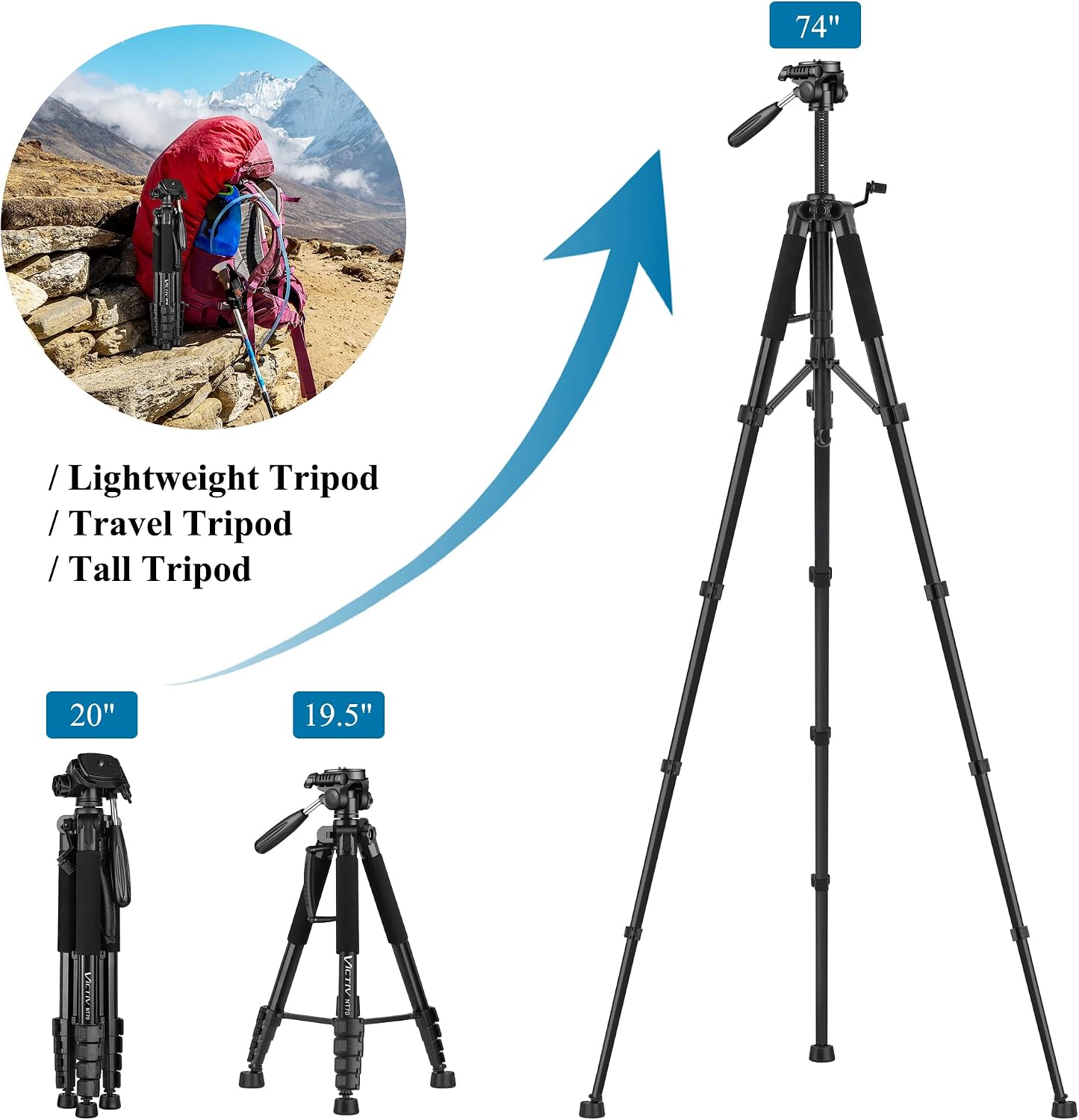
A tripod is just a three-legged stand that holds your camera steady — straightforward enough. But the moment you need to shoot over something — a sideline fence, a row of stadium lights, a crowd of parents at a youth soccer match — you run into a wall that a standard 60-inch tripod can’t clear. “Tall tripods” typically refer to models that reach 70 inches (roughly 178 cm) or more at maximum working height, measured to the top of the ball head before you add any camera. That extra foot or eighteen inches sounds trivial until you’ve spent a tournament weekend hunched behind a lens that keeps catching the top of a chain-link fence in the frame. This article breaks down who actually needs the height, which models come up repeatedly in owner reviews, and — critically — where the hidden costs live so you can budget honestly before you buy.
Who Actually Buys a 74-Inch Tripod (And Why)
Aggregated owner reviews reveal three distinct buyer profiles, and they want very different things from the same category.
Event videographers at kids’ sports are the most consistent purchaser. They’re shooting from the sidelines or bleacher tops, often behind other spectators, and they need the lens elevated above the ambient chaos. The VICTIV 74-inch tripod comes up repeatedly in this context — owners consistently report it as a workhorse for exactly this use case, praising its ability to hold a mid-weight zoom steady at full extension during long tournament days.
YouTube creators clearing physical obstacles form the second group. This one’s counterintuitive: the obstacle isn’t people, it’s architecture — a ceiling-mounted light rig, a studio beam, or stadium infrastructure that sits right in the frame when a camera is at eye level. Reviewers of the K&F Concept ultra-high series (the 90cm folded-length model in particular) specifically call out this use case, and several note that the tripod earns its keep the moment you’re trying to get a clean overhead or elevated wide shot in a constrained interior.
Range shooters mounting spotting scopes are the third group, and they’re a meaningful audience that camera-focused buyers often overlook. A spotting scope — the optic used downrange to read targets — sits on a tripod just like a telephoto lens. Tall tripods let range users sit upright on a bench rather than craning down, and the K&F 90cm-class models come up frequently in this context as well, per owner commentary aggregated across long-run reviews.
The signal here is important: all three groups share the height requirement but diverge sharply on weight capacity, vibration tolerance, and portability needs. That divergence is where the real purchase decision lives.
The Three Models Worth Knowing: Where They Win and Where They Don’t
VICTIV 74-Inch Carbon Fiber / Aluminum Tripod
The VICTIV is the entry point most event shooters land on first. Owners consistently report that it handles the sideline workload — a mid-range telephoto zoom, long shooting sessions, moderate wind — without drama. The leg locks get favorable marks for positive engagement, and the center column extension (the pole in the middle that raises the camera beyond the legs’ reach) is the feature that pushes it past the 70-inch threshold.
The honest caveat: that center column is doing real work at max height. Photography Life’s guide to tripod selection notes that extending a center column beyond halfway introduces a lever-arm effect that multiplies vibration, which is why serious wildlife and sports photographers typically avoid center columns entirely in favor of taller leg sections. At full extension with a long telephoto, owners report that the VICTIV is workable but not surgical — fine for video where minor sway is less visible, slightly more demanding for burst-mode stills of fast action.
K&F Concept Ultra-High Series (90cm Collapsed)
The K&F model that earns the most enthusiastic owner reviews in the tall-tripod category is the ultra-high variant, and the praise centers on two things: zero detectable wobble at working height and precise leg-angle adjustment. Multiple long-run reviewers specifically call out the friction locks and the stability they feel at full extension — a meaningful differentiator in a segment where “tall” and “shaky” are often synonymous.
The hidden hook that owners mention approvingly: the counterweight hook at the base of the center column. Hanging a camera bag or dedicated counterweight from this hook lowers the system’s center of gravity, which directly improves stability at height. This isn’t marketing copy — it’s physics, and Outdoor Photographer’s field notes on tall tripods for wildlife and sports confirm it as a legitimate technique for telephoto work.
One cautionary data point from reviewers: a buyer who purchased the K&F 64-inch model specifically for its tall reach returned it because the collapsed length made it impractical for transport. “Bigger” creates its own storage problem. If your car is a hatchback and your bag is already a 70-liter pack, the collapsed dimensions matter as much as the working height.
CAMBOFOTO Carbon Fiber Tall Tripod
The CAMBOFOTO earns consistent praise for leg quality — specifically the carbon fiber construction, the smoothness of the leg sections, and the build finish. Reviewers repeatedly describe the legs as a premium experience for the price point.
And then almost every review hits the same wall: the included ball head is the weak link. The Phoblographer’s budget tripod round-up confirms this pattern is endemic to the segment — manufacturers spend their margin on the legs and ship a ball head that struggles to hold a heavy body-and-lens combination at steep angles without slow drift. For a camera body plus a 70–200mm f/2.8 or a spotting scope, “drift” means your composition shifts mid-shot.
The honest framing here is a true-cost issue, not a dealbreaker. The CAMBOFOTO legs are worth buying. The included head is worth replacing. That has a dollar value.
The True-Cost Math: Budget for the Head Replacement
If you’re buying the CAMBOFOTO (or any budget tall tripod with a weak included ball head), build the head upgrade into your budget from day one.
By the numbers:
| Component | Typical street price (mid-2026) |
|---|---|
| CAMBOFOTO tall tripod (legs + included head) | ~$120–$160 |
| Entry replacement ball head (Sirui, Desmond) | ~$60–$100 |
| Mid-tier replacement ball head (Really Right Stuff, Arca-compatible) | ~$200–$350 |
| All-in cost with mid-tier head | ~$320–$510 |
At $320–$510 all-in, you’re in the same budget neighborhood as a mid-tier integrated system from Gitzo or Benro. That’s not a reason to avoid the CAMBOFOTO route — the legs genuinely punch above their weight — but it is a reason to frame the purchase honestly rather than anchoring on the sticker price of the tripod alone.
The decision rule: if you’re shooting a body over 1.5 kg with a telephoto longer than 300mm equivalent, budget for the head replacement before you order.
Does Height Kill Portability? The Hiking and Travel Reality
The short answer is: it depends entirely on collapsed length, not working height.
A tripod that extends to 74 inches but collapses to 22 inches is still backpackable. A tripod that collapses to 34 inches is not — it won’t fit in an overhead bin and it will dominate a trail pack. The K&F reviewer who returned the 64-inch model for a shorter collapsed version is the case study here: he wanted the height but didn’t need the bulk on travel days. As Wirecutter’s tripod guide notes, collapsed length is often the more consequential spec for real-world shooters than maximum working height.
If hiking or travel is a meaningful part of your shooting, cross-reference these before buying:
- Collapsed length — target under 24 inches for overhead-bin compatibility
- Weight — carbon fiber saves roughly 30–40% over aluminum at equivalent strength
- Leg sections — more sections collapse shorter but add latching points that can introduce play
Five-section legs get you a shorter collapsed length at the cost of slightly more flex in the leg tubes. For static event shooting or range work, that trade is worth it. For windy hilltop landscapes with a telephoto, it’s less forgiving.
Frequently Asked Questions
How stable are these tall tripods at full extension with a heavy telephoto lens?
Stability at full extension is the defining challenge of the category. Owners report that the K&F ultra-high model performs best here — reviewers specifically describe zero wobble under working loads — while the VICTIV is workable for video but less ideal for precision stills at max height. Per Photography Life’s tripod guide, the center column is always the weakest link: a tripod that reaches 74 inches only via a fully extended center column will vibrate more than one that achieves the same height through longer legs. When stability matters, look for models that hit your target height through leg extension rather than center-column travel, and use the counterweight hook if one is available.
Can you mount a spotting scope on a camera tripod?
Yes, and it’s a common crossover use case. Most spotting scopes ship with a standard ¼-20 or 3/8-inch mounting thread — the same standard used on camera tripods — so they drop right onto a ball head. Outdoor Photographer’s field notes confirm that range shooters and wildlife observers regularly run spotting scopes on camera tripods, with tall tripods preferred for bench shooting because they allow a comfortable upright posture. The critical variable is load capacity: a large spotting scope plus a heavy eyepiece can approach 2–3 kg, so verify the tripod’s rated capacity before mounting.
What does ‘detachable monopod’ mean in practice and is it useful?
Some tall tripods — several K&F and CAMBOFOTO models among them — allow one leg to be detached and used as a standalone monopod (a single-leg support). In practice, owners report it’s genuinely useful for event shooting: you plant the tripod for a wide locked-off shot, detach a leg to follow action with the monopod, then reassemble. The execution varies by model — thread quality and lock security are the variables to watch. It adds real versatility for sports and event work without adding meaningful weight.
Should I replace the ball head on a budget tall tripod, and what does that cost?
If your camera-plus-lens combination exceeds roughly 1.5 kg, yes — budget for it. The pattern documented in The Phoblographer’s budget round-up is consistent: budget tripods allocate their cost to the legs, not the head, and the included head shows it under load. An entry-level Sirui or Desmond ball head runs $60–$100 and will hold position reliably under a mid-weight zoom. A mid-tier Arca-compatible head runs $200–$350 and is appropriate for heavy telephotos or spotting scopes. Factor this into your total budget from the start.
Does extra height hurt portability for hiking or travel?
It depends on collapsed length, not working height — these are independent specs. A tall tripod with a short collapsed length (under 22–24 inches) can be as portable as a standard tripod. The K&F reviewer who returned a tall model did so because the collapsed length was the real problem, not the height. Check collapsed length first when portability matters; working height second. Carbon fiber cuts weight meaningfully if you’re covering distance on foot.