June 6, 2026 • Declan Marsh • 9 min reading time • Prices verified June 11, 2026
The Waterproof Point-and-Shoot Question: Kodak WPZ2 and Who It's Actually For
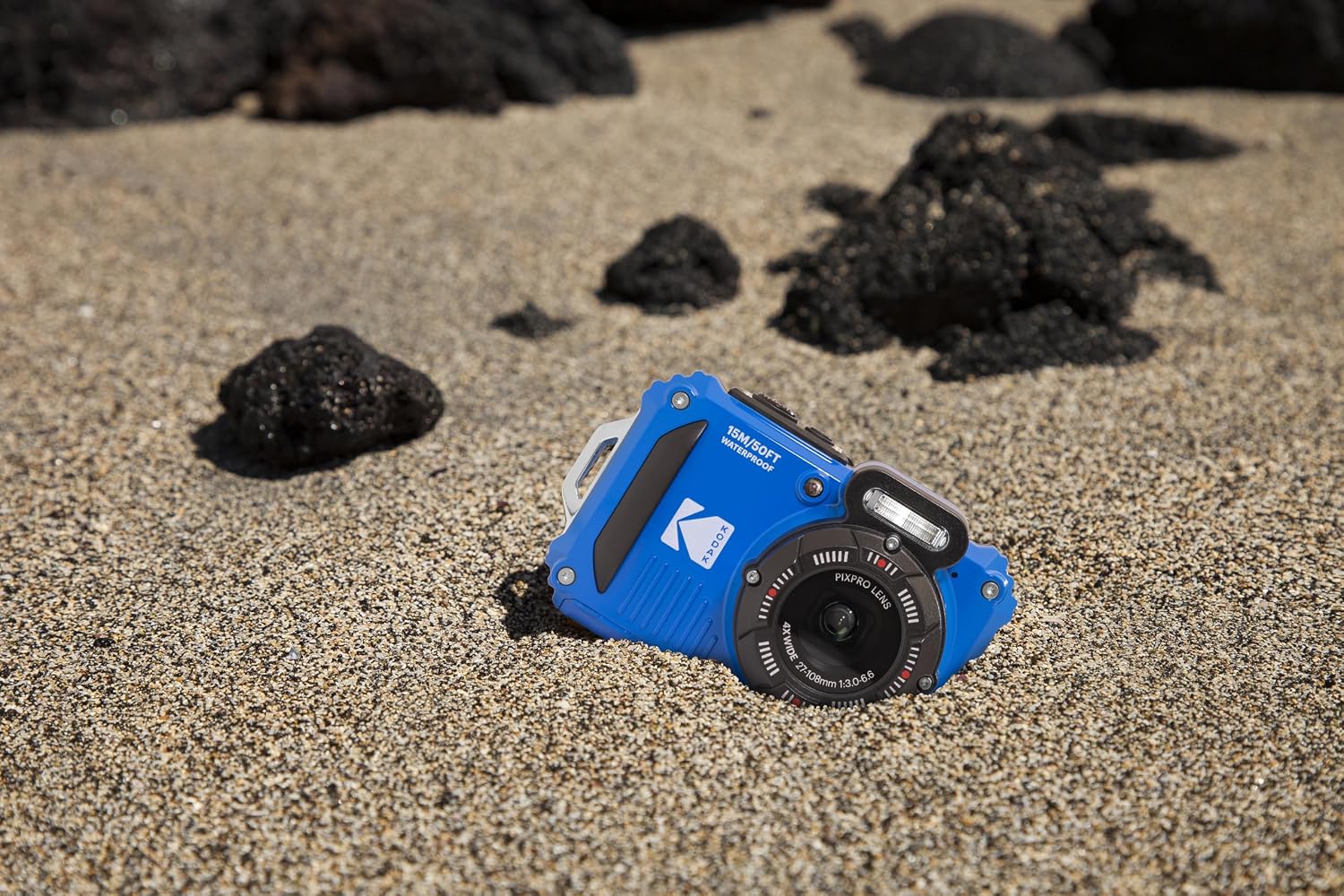
A point-and-shoot is exactly what the name says: a camera that handles focus, exposure, and most technical decisions automatically, so you just aim and press the button. No lens-swapping, no menu archaeology, no $200 filter kit required. They fell out of fashion when smartphones got good — but a specific group of situations keeps pulling them back into relevance: water, sand, impacts, and the desire to simply not worry about your phone surviving the trip. If you’ve been weighing whether a waterproof compact actually earns its place in your bag — or whether the Kodak WPZ2 is the right one — this article walks through the real-buyer calculus. We’ll cover what owners actually report, where each camera falls short, and how to match yourself to the right tool before you spend money on the wrong one.
What the Kodak WPZ2 Actually Is (and Isn’t)
The WPZ2 is a waterproof point-and-shoot — meaning it carries an IPX8 rating (manufacturer-rated to 10 meters submersion depth) and is built to survive rain, splashes, and the casual aquatic abuse of a day on the water. It weighs 176 grams, which spec sheets confirm is lighter than most current flagship smartphones. Charge time runs one to two hours, which owners cite repeatedly as a genuine practical win, particularly for multi-day trips where outlet access is limited.
The sensor is a 16-megapixel 1/2.3-inch CMOS — the same class of sensor that has powered budget compacts for years. That matters because it sets a ceiling on image quality: 1/2.3-inch sensors (small chips, roughly the size of your thumbnail) produce images that are acceptable in good light but degrade noticeably in low light compared to larger sensors found in enthusiast compacts or full-frame mirrorless bodies.
Across aggregated owner reviews, two things stand out. First, the anti-shake feature — an optical image stabilization system (meaning the camera physically compensates for hand movement rather than just adding software blur) — earns unusually specific praise. One reviewer explicitly credited it with salvaging every usable photo during a kayaking trip taken during a physically unstable post-trauma recovery period. That’s not a generic “the stabilization is good” review; it’s a vivid account of a real use case where the feature changed the outcome. Second, the fun effects modes, including a “dreamy” filter mode, are mentioned positively by buyers rather than dismissed as gimmicks — which tells you something about the emotional register of its owners.
The Phoblographer’s waterproof compact roundup and Wirecutter’s point-and-shoot guide both note that in this price and sensor class, you’re buying ruggedness and convenience, not image quality. Own that trade-off clearly and the WPZ2 delivers. Expect it to compete with a 2022 flagship smartphone camera and you’ll be disappointed.
The Comparison Set: Four Cameras, Four Distinct Buyers
Understanding who the WPZ2 is for gets sharper when you put it next to three alternatives that buyers often consider in the same breath.
Kodak FZ55 — The Beginner Travel Compact
The FZ55 is a non-waterproof fixed-lens compact with a 5x optical zoom and a similar sensor class to the WPZ2. Reviewers describe it as beginner-friendly, sharp for its class, and colorful — one buyer documented an entire Ireland trip on it and came back satisfied. The colors are punchy rather than technically neutral, which is a feature for casual travel and a mild drawback if you intend to shoot RAW and recolor in post (note: the FZ55 does not shoot RAW).
Practical note for buyers: The FZ55 uses a standard microSD card (the small format used in phones) rather than a full-size SD card. That trips up first-time compact buyers who assume all cameras use the same storage format. PopPhoto’s budget compact overview confirms this as a recurring point of confusion in buyer feedback. You’ll want a Class 10 / UHS-I microSD of at least 32GB — a commodity purchase, but worth adding to the budget.
Kodak C1 — The Nostalgia-First Social Camera
The C1 occupies a different register entirely. Reviewers are frank about what it is: a camera that deliberately evokes the early-2000s digital aesthetic — the slightly soft, overexposed, high-saturation look of a 2003 party photo — and is built to be passed around at bars, events, and gatherings. One buyer states plainly that it is “not a high-resolution camera” and buys it anyway, specifically because the low-resolution output is the point.
The C1 includes a flip-up screen, which makes it functional for selfies and casual vlogging — the framing question is answered, even if the image quality ceiling remains modest. If your reader’s use case is social documentation where atmosphere and portability matter more than sharpness, the C1’s positioning is honest and the buyers who purchase it with clear expectations report satisfaction. The buyers who purchase it expecting smartphone-quality images do not.
Panasonic FZ80D — The Superzoom Bridge Camera
The FZ80D earns its own category. It is a bridge camera — meaning it bridges the gap between a compact and a DSLR by offering a large zoom range (60x, or roughly 20–1200mm equivalent) in a single, fixed-lens body. It is not small, not light, and not a casual carry camera.
One particularly instructive four-star owner review — flagged consistently in aggregated feedback — warns buyers directly: the FZ80D has a small sensor, and the 60x zoom is the entire value proposition. If you need to photograph a bird 400 meters away or frame a speaker on a stadium stage from the back of the venue, this camera has no peer in its price class. If you’re evaluating it as a general compact, you’re buying the wrong tool.
DPReview’s compact camera buyer’s guide reinforces this framing: superzoom bridge cameras sacrifice low-light performance and image quality in exchange for reach. That’s a legitimate trade-off for wildlife, sports, and event coverage where proximity isn’t an option — it’s the wrong trade-off for everything else.
By the Numbers
| Camera | Weight | Waterproof | Sensor | Zoom Range | Key Audience |
|---|---|---|---|---|---|
| Kodak WPZ2 | 176g | Yes (IPX8, 10m) | 16MP 1/2.3” | 4x optical | Water/outdoor active |
| Kodak FZ55 | ~130g | No | 16MP 1/2.3” | 5x optical | Beginner travel |
| Kodak C1 | ~115g | No | Low-res | Fixed | Social/nostalgia |
| Panasonic FZ80D | ~567g | No | 18MP 1/2.3” | 60x optical | Reach-first zoom |
Specs per manufacturer published documentation. Weights approximate.
The Image Quality Question Answered Honestly
The honest answer to “how does the WPZ2 compare to a modern smartphone camera?” is: in most conditions, a current mid-range or flagship phone will produce sharper, better-exposed, better-in-low-light images. Smartphone computational photography — the software processing that stacks multiple exposures, sharpens edges, and manages noise — has closed the gap with small-sensor compacts almost entirely in daylight, and surpassed them in low light.
What the WPZ2 offers is not better image quality. It offers survivability and presence in situations where a phone is a bad idea. Kayaking, snorkeling, beach days with blowing sand, river hikes in the rain — these are contexts where the physical risk to a $1,000 phone creates a real decision problem. The WPZ2 at a fraction of that cost, rated to 10 meters, is a different category of tool.
PetaPixel’s 2025 piece on the case for point-and-shoots makes this argument cleanly: the question isn’t whether a compact outperforms a phone on a bench test. It’s whether you’ll actually bring it into the water. The WPZ2 wins that question by default.
Frequently Asked Questions
Is the Kodak WPZ2 actually waterproof enough for kayaking and beach use?
Based on the manufacturer’s IPX8 rating (10 meters submersion), yes — it is rated for the water exposure involved in kayaking, snorkeling, and beach use. Real-world owner reports align with this: owners on extended paddling trips and beach vacations report no water damage under normal active use. The rating does not cover pressurized water (like a strong dive entry) or salt-water damage over extended periods without rinsing. Rinse with fresh water after salt-water exposure; that applies to any waterproof camera.
How does the image quality of the WPZ2 compare to a modern smartphone?
In daylight and good light, image quality is comparable to a mid-range smartphone from roughly 2021–2022 — serviceable, printable up to about 8x10 inches, social-media-ready. In low light, a current flagship smartphone will outperform it. The WPZ2’s advantage is not image quality; it’s the ability to be in situations where a phone can’t go. Own that trade-off and it’s a useful camera.
What SD card does the Kodak FZ55 need?
The FZ55 uses a microSD card, not a standard full-size SD card. A Class 10 / UHS-I rated microSD of at least 32GB is the practical minimum. 64GB is widely available at low cost and provides comfortable headroom for a multi-day trip. Check packaging or the manufacturer’s spec sheet for the maximum supported card size before buying high-capacity cards.
Is the Kodak C1 flip screen useful for selfies and vlogging?
Functionally, yes — the flip screen solves the framing problem for self-portrait and front-facing video use. But the image quality ceiling is low. The C1’s buyers who report satisfaction are using it for social events and nostalgic aesthetic output, not vlogging that requires clean, sharp footage. If you’re building a vlogging setup where image quality matters, the C1’s sensor will frustrate you. If you want a disposable-aesthetic, low-stakes party camera with a flip screen, it works as intended.
Who should choose the FZ80D zoom range over a smaller compact?
Anyone whose primary use case requires extreme reach — wildlife photography, birding, sporting events, concerts from the back of the venue, airshows. If you regularly need to photograph subjects that are far away and inaccessible, the FZ80D’s 60x zoom range has no real competition in a fixed-lens body at its price point. If your subjects are at normal human distances — travel, family, social — the FZ80D’s size and image quality trade-offs don’t justify the zoom. Buy the smallest camera that handles your actual use case, not the one with the most impressive number on the spec sheet.
The Decision Rule
The WPZ2’s owner base is telling you something instructive: the people who use it consistently are defined not by budget constraints but by specific physical environments. Water. Instability. Risk of loss or damage. If those conditions describe your shooting context — even occasionally — the WPZ2 earns its place in the bag as a dedicated tool, not a compromise.
- If you need a compact for dry travel: the Kodak FZ55 gives you slightly better image quality and a lighter carry.
- If you need the nostalgic social camera aesthetic: the Kodak C1 is honest about what it is, and its buyers who understand that are satisfied.
- If reach is your entire value proposition: the Panasonic FZ80D is the right tool, but enter with clear eyes about the sensor.
- If you’re going near water, sand, or any environment hostile to a phone: the WPZ2 is the answer. The anti-shake system, the 1-2 hour charge time, the 176-gram carry weight, and the IPX8 rating combine into a camera that exists specifically for the trip where everything else is too fragile to bring.
The smartest buy in this category isn’t the highest-spec one. It’s the one you’ll actually take with you.